I can tell within five minutes if a student has a proper practice space at home.
The one making steady progress? Has a dedicated spot where everything they need is within reach.
The student who “practices an hour a day” but shows up with no progress? Practicing in front of the TV, or where they’re interrupted every ten minutes, or in a space where they have to dig through a closet to find their tuner.
Your practice space matters. Not because you need some Instagram-worthy setup.
Because disorganization and distraction kill progress.
Here’s what actually matters.
Why Most People's Practice
Spaces Don't Work
The kid practicing in the family room while siblings watch TV, parents cook dinner, and the dog runs through. Then parents wonder why their child “doesn’t focus.”
The adult who keeps their guitar in the case in a closet, with their tuner in a drawer, their music somewhere else, and their capo… who knows. By the time they’ve gathered everything, they’ve lost 10 minutes and half their motivation.
The student who practices at the kitchen table with terrible lighting, uncomfortable seating, and constant interruptions.
None of these setups are accidents. They’re what happens when people don’t think intentionally about their practice environment.
What a Good Practice Space
Actually Looks Like
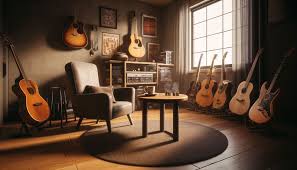
The ideal setup is a dedicated room. Door you can close. Good lighting. Comfortable temperature. Guitar on a stand where you can see it.
But most people don’t have that. And that’s fine.
Here’s what you actually need:
A spot where your guitar lives – on a stand (or wall hanger), visible, accessible. If it’s in a case in the closet, you won’t play it as much.
Everything within reach – tuner, picks, capo, music stand, whatever you use regularly. If you have to hunt for stuff every time, you won’t practice as much.
Minimal distractions – Turn the TV off. Put the phone in another room. Tell your family “I’m practicing for 30 minutes, please don’t interrupt unless it’s urgent.”
Decent lighting – I’ve had students practice in dimly lit corners. They don’t realize why practice feels so unpleasant – it’s the eye strain, the discomfort, the fact that everything just feels harder than it needs to be.
That’s it. You don’t need a recording studio. You need a functional space that doesn’t fight you.
The Portable Setup
(For People Without Dedicated Space)
If you can’t leave everything set up, get a box or crate.
Put everything you need in it: tuner, picks, capo, music/tabs, metronome, pencil and paper.
When it’s practice time, grab the box. Set up. Practice. Put it away.
This takes 2 minutes instead of 10 minutes of hunting. That difference matters.
What You Actually Need
Essential:
- Tuner (your guitar needs to be in tune, period)
- Music stand (or somewhere stable to put your music)
- Metronome (timing matters more than most people think)
- Picks and capo within reach
- Decent lighting
Useful:
- Recording device (your phone works – record yourself occasionally to hear what actually needs work)
- Extra strings (so you’re not stuck when one breaks)
Nice but not essential:
- Drum machine (metronome works fine)
- Fancy musician furniture
- Elaborate organization systems
Most people overthink this. Start with essentials. Add more if you actually use it.
The One Thing That Actually Matters Most
The best practice space is the one you’ll actually use.
A perfectly organized room that you avoid because it feels isolated? Useless.
A corner of your bedroom with a stand, a chair, and minimal distractions? Perfect.
Don’t let “perfect” stop you from “good enough to actually practice.”
What I See Working
Students who make the most progress:
Their guitar is visible. On a stand (or wall hanger). In the room where they spend time. Not hidden away.
They have a spot. Doesn’t have to be fancy. Just consistent.
They minimize interruptions. They communicate with family. They turn off distractions. They treat practice time as protected.
They keep it simple. Guitar, tuner, music, metronome. That’s enough.
Students who struggle? Usually practicing in chaotic environments, with no consistent setup, surrounded by distractions.
Sometimes the space is the problem.
Fix Your Space, Improve Your Progress
If you’re not making the progress you want, look at your practice space honestly:
- Can you access your guitar easily, or is it buried in a closet?
- Do you have to hunt for your tuner, picks, and capo every time?
- Are you trying to practice with the TV on, or in the middle of household chaos?
- Is your lighting terrible and your seating uncomfortable?
These things seem minor until you realize they’re costing you 10-15 minutes of every practice session, plus constant interruption to your focus.
Fix the space. Watch what happens to your progress.
The Bottom Line
You don’t need a perfect practice space. You need a functional one.
A spot where your guitar lives, visible and accessible. Everything you use regularly within reach. Minimal distractions. Decent lighting.
Most people never set this up intentionally. They wonder why practice feels like such a hassle.
Sometimes it’s not about discipline. It’s about environment.
Set up your space properly. Make practice easy to start and hard to interrupt.
Then watch how much more you actually practice – and how much faster you progress.
About The Author
Brian Fish is a professional guitarist who has been dedicated to helping other guitar players in Northeast Ohio pursue their musical dreams since 1994. He’s passionate about guiding others on their musical journey! He is the Guitar Playing Transformation Specialist, instructor, mentor, trainer, and coach at
Guitar Lessons Geauga.
Brian has also assisted people from around the globe in developing a solid sense of timing and enhancing their creativity through the fantastic rhythm course, “Ultimate Rhythm Mastery,” available at MusicTheoryForGuitar.com.
If you live in Geauga County / North East Ohio, Guitar Lessons Geauga can help you become the player you’ve always wanted to be.