Most beginners struggle with chord changes because they’re doing one thing wrong:
They place their fingers one at a time instead of all together.
This makes chord changes slow, hesitant, and inconsistent. You’re always behind the beat, fumbling to get fingers in place.
The solution: Train your fingers to move as a unit, land simultaneously, and know exactly where they’re going.
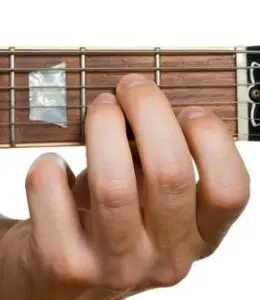
Here are six exercises that actually work.
1. Memorize Your Shapes
You can’t change chords smoothly if you’re still looking at diagrams every time.
Put away the chord charts. Test yourself. How many chord shapes can you recall from memory?
Exercise: Get blank chord diagrams and draw out all the shapes you know without reference. This forces recall and reinforces learning away from your guitar.
You can find blank chord sheets online easily – just search “blank guitar chord diagrams.”
Do this regularly. The goal is automatic recall: You think “G chord” and your fingers immediately know where to go.
2. Chord Push-Ups (Build Muscle Memory)
This is the foundation exercise for training fingers to move together.
How to do it:
- Form a chord with all fingers in correct position
- Push all fingers down simultaneously
- Relax all fingers at the same time
- Repeat 5 times
- On the 6th time, lift fingers slightly off strings when you relax
- Place all fingers back down simultaneously, maintaining chord shape
Start with fingers barely lifting off strings. As this gets easier, gradually increase the distance.
The key: Your fingers move as a unit. All down together. All up together. No one-at-a-time finger placement.
This feels awkward at first. That’s normal. Your brain is learning new motor patterns.
3. Machine Gun Exercise
This improves your ability to switch between chord shapes and single-note playing.
How to do it:
- Choose one chord (or sequence of chords)
- Play the chord
- Lift all fingers and strum down-up-down-up on a single string
- Place all fingers back down simultaneously in chord shape
The single-string strumming forces you to completely reset between chord formations. Your fingers can’t cheat by hovering near their positions.
This develops clean entry and exit from chord shapes.
4. Slow Motion Changes
For chord changes that consistently trip you up, slow motion practice reveals exactly what’s going wrong.
How to do it:
- Pick two chords – one you struggle with
- Form the first chord, all fingers down
- Lift all fingers simultaneously
- Slowly move fingers toward new chord shape, hovering just above strings
- Hold the hover until you’ve formed the complete new shape
- Place all fingers down simultaneously
Do this as slowly as necessary. The goal isn’t speed – it’s training your fingers to form the shape in the air before touching strings.
Practice a few minutes each session until the transition feels natural.
5. Lightning Round (Track Your Progress)
This gives you measurable progress tracking.
How to do it:
- Pick two chords
- Set timer for 60 seconds
- Count how many clean changes you complete
- Write down your number
Next practice session, try to beat your previous count by at least one.
This creates tangible improvement metrics. You’re not guessing whether you’re getting better – you’re tracking it.
6. Focus Rotation (Identify Problem Fingers)
Most chord change issues come from one or two fingers lagging or leading.
How to do it:
- Pick a chord change to work on
- Do 5 changes while focusing only on your first finger – watch its movement
- Do 5 changes focusing only on second finger
- Repeat for third and fourth fingers
This reveals which finger is the problem. Usually one finger arrives early (waits for others) or late (holds up the change).
Once you identify the problem finger, you can consciously correct it.
Bonus Tips That Actually Help
Look for anchor fingers: Some fingers stay in the same position between chords. Example: Ring finger stays put when moving G → D → Em7 → Cadd9. Recognize these and you have one less finger to worry about.
Play along with songs: Start by strumming only on beat 1 of each measure. This gives you time to think about and form the next chord. If even this is too fast, practice without strumming – just move your fretting hand in time with the song.
Use a metronome: Practice at slow, consistent tempo. Gradually increase speed only after you can do it cleanly at current tempo. Always practice at the edge where you struggle just a little – not so slow it’s easy, not so fast you’re sloppy.
Common Mistakes I See
Placing fingers one at a time: This is the default for beginners. Break this habit immediately with chord push-ups.
Not actually memorizing shapes: You keep looking at diagrams session after session. Force recall by practicing without reference.
Practicing too fast: Speed comes from accuracy at slower tempos. Practice clean changes slowly before trying to speed up.
Giving up on difficult transitions: Everyone has chord changes that feel impossible at first. Slow motion practice makes them possible.
Not tracking progress: Without measurable benchmarks (like the lightning round), you don’t know if you’re actually improving.
Why This Is Hard to Learn Alone
Here’s the reality: You can’t see what your fingers are actually doing.
You think they’re landing together. They’re not. One finger is consistently late.
You think you’re forming the chord shape correctly in the air. You’re not. Your fingers are drifting to wrong positions.
An experienced – trained teacher watching your hand spots these issues immediately and corrects them before they become ingrained habits.
Without that feedback, you might practice incorrectly for weeks, reinforcing the wrong patterns.
These exercises give you the framework. But if chord changes still feel impossible after consistent practice, you need someone watching your hand and giving real-time corrections.
The Bottom Line
Smooth chord changes come from:
- Memorized shapes (automatic recall)
- Fingers moving as a unit (not one-at-a-time)
- Consistent practice at appropriate tempo
- Measurable progress tracking
Use these exercises. Practice them consistently. Track your improvement.
Chord changes will go from impossible to automatic.
But it takes time and correct practice. Don’t expect overnight results. Expect steady improvement over weeks and months.
That’s how everyone learns this. There are no shortcuts.
About The Author
Brian Fish is a professional guitarist who has been dedicated to helping other guitar players in Northeast Ohio pursue their musical dreams since 1994. He’s passionate about guiding others on their musical journey! He is the Guitar Playing Transformation Specialist, instructor, mentor, trainer, and coach at Guitar Lessons Geauga.
Brian has also assisted people from around the globe in developing a solid sense of timing and enhancing their creativity through the fantastic rhythm course, “Ultimate Rhythm Mastery,” available at MusicTheoryForGuitar.com.
If you live in Geauga County / North East Ohio, Guitar Lessons Geauga can help you become the player you’ve always wanted to be.