
I played in a band with a guy who’d been performing for over 40 years.
Great voice. Charismatic. People loved him.
But we could never take a request.
We couldn’t change the setlist on the fly.
Every song required him to shuffle through his binder, find the right lead sheet, and get it set up in front of him before we could start.
The rest of us would just stand there… waiting.
Here’s the thing that killed me: I have students who’ve been learning guitar for two years who are more gig-ready than he is.
They can play songs from memory. They can adjust on the fly. They can actually respond when someone at a party says, “Hey, do you know any Tom Petty?”
Not because they’re more talented than him.
Because they were trained differently.
The Difference Between Playing and Training
See, this guy had been playing guitar for four decades — gigging, performing, having fun.
But he’d never actually been trained.
Nobody had ever shown him how to build the foundational skills that make you truly independent on the instrument.
He’d learned songs. Lots of them. But always the same way — by reading. By following. By relying on something in front of him to tell his fingers where to go.
And after 40 years? That’s still all he could do.
He’d spent four decades collecting information… but he’d never developed the deeper abilities that turn information into actual performance skill.
It’s like the difference between knowing the rules of basketball and being able to play basketball.
One is just facts. The other is trained ability.
The Athletic Approach to Guitar
When athletes train, they don’t just memorize plays or study diagrams.
They drill fundamentals. They build coordination. They develop reflexes so automatic that their body can execute under pressure without thinking.
A pitcher doesn’t just learn about throwing — he conditions his arm, his timing, his release point through thousands of repetitions until it becomes second nature.
That’s what separates someone who plays recreationally from someone who performs like a pro.
Musicians need to approach guitar the same way.
You’re not just learning about music — you’re conditioning your hands, ears, and brain to work together automatically.
And just like in sports, that means training multiple skills at once, not just focusing on one thing.
The "One Muscle" Mistake
Imagine a bodybuilder who only trains his biceps.
He walks into the gym, grabs the same dumbbells every day, curls until his arms burn, and calls it a workout.
After a few months, he’s got impressive arms… but the rest of his body looks completely out of balance. His legs, back, and core can’t support what he’s built. He looks strong in one place — but he’s not actually strong.
That’s what happens when you only focus on one musical skill — like memorizing songs or drilling scales — while ignoring everything else.
You might get good at that one thing, but your overall musicianship stays weak.
And you end up like my bandmate — able to play, but never truly independent.
If you want to become a great guitar player — not just someone who can copy others — you have to train your whole musical body.
The Skills That Make You a Musician
So what exactly are those “musical muscles” you need to build?
Here are the most important ones:
Fretboard Knowledge
Knowing where notes live on the fretboard is like knowing the layout of a playing field. You can’t move confidently if you don’t know your territory.
When you know your fretboard, everything becomes easier — learning songs, improvising, writing, and even communicating with other musicians.
My bandmate? He could play the notes when they were written in front of him. But he didn’t really know where they were or why they worked. So the moment the paper was gone, so was his ability.
Theory and Understanding
Music theory isn’t just for classical players. It’s the framework that explains why things sound good together.
If you want to write your own songs, improvise, or even understand how your favorite riffs are built — theory gives you the tools. It turns random notes into deliberate choices.
Rhythm and Timing
Rhythm is the backbone of everything you play. Without solid timing, even great notes and technique fall apart.
Building strong rhythmic awareness makes your playing feel locked-in and confident — whether you’re strumming chords, playing lead, or jamming with others. It’s what makes a guitar player sound like a pro even if they only play as a hobby.
Coordination and Control
Playing guitar means training both hands to work together — and that takes real coordination.
Your fretting hand shapes the notes; your picking hand controls rhythm, tone, and feel. Getting them to move in sync is like a pitcher perfecting the timing between his windup and release.
Muting and Tone Control
One of the biggest marks of a mature player is clean playing — no unwanted string noise, no buzz, no sloppy ringing.
Learning how to mute strings with both hands takes time and awareness. But once you master it, everything you play sounds tighter, more professional, and more confident.
Ear Training
Your ears are your most powerful musical tool.
Ear training helps you recognize chords, intervals, rhythms, and melodies — so you can learn faster, improvise better, and actually hear what’s happening in the music.
It’s the difference between guessing and knowing. When your ears are sharp, the guitar becomes an extension of what you hear in your head.
This is what my bandmate never developed. His ears couldn’t fill in the gaps when the paper wasn’t there.
Why You Need a Coach (Even the Pros Do)
Even professional athletes spend huge amounts of time on the basics — refining movement, coordination, and control until every action is second nature.
And here’s what’s important: even at the highest levels, they still work with coaches and trainers.
Why? Because no matter how good you get, you can’t see yourself from the outside. You can’t catch every habit, every inefficiency, every small adjustment that could make you better.
The feedback, correction, and expert eye is what keeps pros improving instead of just reinforcing the same patterns over and over.
They don’t just know how to move; they’ve trained those movements so thoroughly that their body can execute them automatically, even under pressure.
Musicians need to approach guitar the same way.
You’re not just learning about music — you’re conditioning your hands, ears, and brain to work together automatically. And just like in sports, having the right coach or trainer makes all the difference.
Why Most Teachers Don't Train This Way
But here’s the problem with most guitar teachers:
They see themselves as information-givers.
They show songs, scales, or bits of theory — but they don’t actually know how to train guitar players to get results that matter. The kind that make you stand out and sound far better than the average hobby player.
Even worse, many let students decide what they want to learn each week, which almost guarantees slow progress and frustration.
Great teachers don’t do that.
Great teachers think like athletic trainers.
They know how to help you strengthen every part of your musical skill set — technique, rhythm, ear, theory, control — and integrate it all into one confident, expressive performance.
And they make the process fun, structured, and results-driven.
They don’t just fill your head with facts; they train your hands, your ears, and your mind to work together.
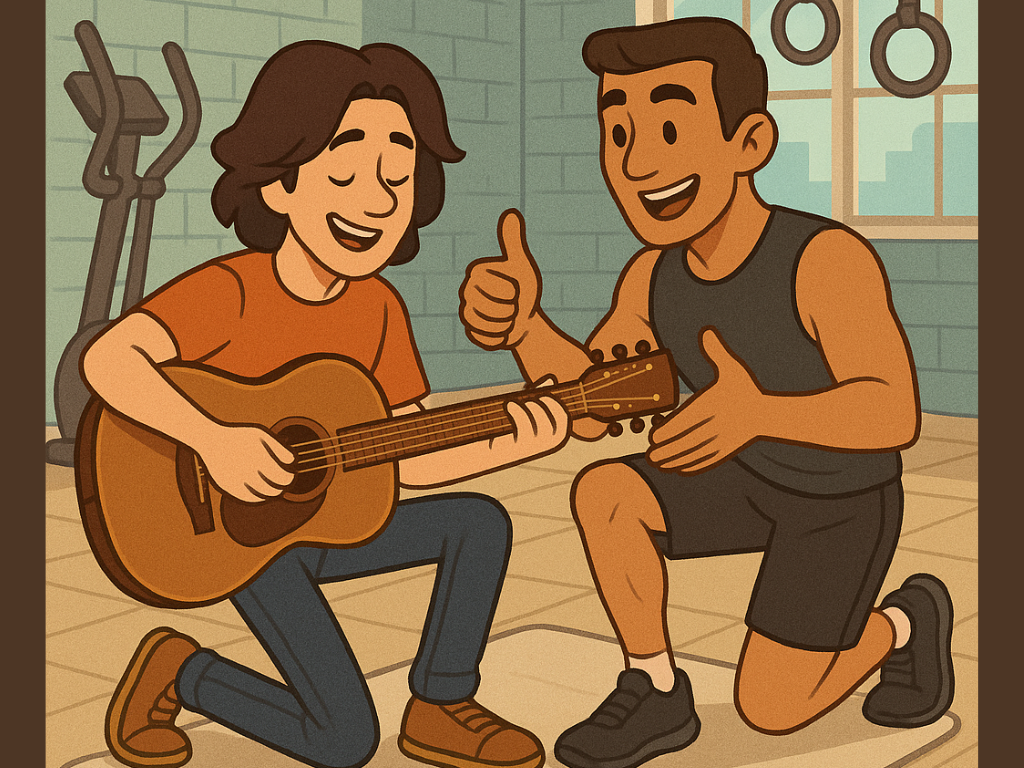
When you find a teacher who thinks this way — and is actually trained to train — you’ve hit the jackpot.
That’s how you develop real control, confidence, and the ability to sound good when it counts — whether that’s in a band, a jam session, or your living room.
Don't Waste 40 Years
If you only chase information — playing parts of songs, collecting scales, or copying licks and riffs — it can be fun for a while, but eventually, frustration sets in.
You’ll start to feel stuck, and your playing will probably be very unbalanced.
Like the bodybuilder with giant arms and no legs, your progress will look impressive in one small area — but completely fall apart in others that truly matter.
Or worse — you’ll end up like my bandmate. Decades of experience, but still dependent on a piece of paper to tell you what to do.
But when you train like an athlete — developing coordination, technique, awareness, and control together — everything improves faster.
You’ll feel more confident.
You’ll sound cleaner.
And you’ll be able to express yourself freely, without your technique holding you back.
Because learning music isn’t about collecting knowledge — it’s about building the ability to perform, even if it’s just to entertain yourself.
Ask Yourself This
Are you learning about guitar… or are you actually being trained to play guitar?
There’s a difference.
And that difference will show up every time you try to perform — whether that’s on stage, at a jam session, or just for yourself in your living room.
Train smart.
Stay consistent.
And make sure you’re working on your whole musical body.
That’s how you go from learning guitar… to actually becoming a guitar player who impresses themselves — and everyone else who hears them.

About The Author
Brian Fish is a professional guitarist who has been dedicated to helping other guitar players in Northeast Ohio pursue their musical dreams since 1994. He’s passionate about guiding others on their musical journey! He is the Guitar Playing Transformation Specialist, instructor, mentor, trainer, and coach at
Guitar Lessons Geauga.
Brian has also assisted people from around the globe in developing a solid sense of timing and enhancing their creativity through the fantastic rhythm course, “Ultimate Rhythm Mastery,” available at MusicTheoryForGuitar.com.
If you live in Geauga County / North East Ohio, Guitar Lessons Geauga can help you become the player you’ve always wanted to be.