
Transcribing is one of those words that makes most students nervous. When I bring it up in lessons, I can almost see the resistance — they picture sitting at a desk with manuscript paper, painstakingly writing out every note of a complex solo. That sounds daunting if you have never done anything like that before. No wonder they don’t want to do it.
But that’s not what transcribing actually is — or at least, it’s not where it starts.
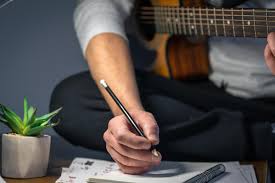
Transcribing is simply the process of listening to a recording and figuring out how to play what you hear. Then writing it down so you don’t lose it. That second part is the one most people skip. And I know from personal experience exactly what that costs you.
Why I Write Everything Down Now
When I’m in a band and performing regularly, I can remember everything we play. My current band has over 80 songs on our set list, and I know them all because we play them all the time. That’s how memory works — regular repetition keeps things in your head.
But when I’m not in a band? When I’m not worrying about performing every week? That number drops to maybe ten songs I could play all the way through. That’s it. And that’s normal — it happens to everyone.
This is where transcribing makes all the difference. When I want to start performing again, I’m not starting from scratch. I can pull out my transcriptions and relearn things fast because the work is already done — the chords, the structure, the rhythm, it’s all there on paper waiting for me.
I didn’t always do this. I can look at set lists from my first two bands and remember playing every one of those songs — I remember rehearsals, I remember the gigs, I remember how they felt. But I didn’t write any of it down, so if I wanted to play those songs today, I’d have to learn them from scratch like I’d never heard them before.
The one that really stings is an original band I was in during my 20s. We wrote those songs. We practiced and performed them constantly. They were long, somewhat complex pieces that we put real work into creating. I cannot remember a single one of them now. All those songs, all that work — completely lost. If I wanted to play them again, I’d have to treat them like any other song and learn them from the recording as if someone else wrote them. That’s what not writing things down costs you.
Where to Start
Most people assume transcribing means starting with notes on a staff. It doesn’t. For strum-based songs, I have students start with the simplest thing that’s actually useful: a chord chart. Listen to the song, figure out what the chords are, how many beats or measures each chord gets, and map out the general structure — verse, chorus, bridge, how many times through. The student is building this from scratch by listening, not copying something off the internet. That’s the actual work, even at the most basic level.
Once you have the chord chart, then you add the rhythm and strum pattern you want to use for the different parts. Now you have something you can actually use to play the song — and something you can come back to months or years later and relearn quickly.
One thing that helps from the very beginning: sing or hum the part you’re trying to figure out. You don’t need a great voice for this — you can sound awful and only be close to the pitch, and it will still help. Singing a passage is one of the fastest ways to get what you’re hearing in your ear to your fingers on the fretboard. Don’t wait until after you’ve transcribed something to start doing this — it should be part of the process from the first note.
For riff-based songs or solos, it depends on the student. Some do better finding the rhythm first and adding the notes after. Others want to get the notes down first and add rhythm later. Both approaches work. What matters is that by the end, you have something complete — notes and rhythm together.
Here’s the mistake I see constantly: students write down the notes with no rhythm. Just a string of pitches with no indication of timing, duration, or feel. That gives you maybe half the information you need. Try coming back to that six months later and relearning the song. You’ll be staring at a list of notes with no idea how they actually fit together. You might as well start over.
You Will Get Things Wrong
One of the reasons students resist transcribing is they’re afraid of doing it badly. They listen to a passage, can’t quite figure out what’s happening, and freeze up rather than write down something that might be wrong.
Here’s what I tell them: you are going to get things wrong. Especially at the beginning. That is completely fine because you are still learning — learning to hear root notes, learning to identify rhythms, learning how the guitar neck maps to what your ears are picking up. All of that takes time, and the only way to develop those skills is to actually do the work, imperfectly, and keep at it.
Eventually, you move on to hearing how intervals feel over each chord, and that opens up a whole new level of understanding. But you don’t start there. If you only get one measure right, or even just the first few notes, you still have something. That’s more than you had before you started. And it gets easier the more you do it.
I look at some of my early transcriptions and laugh. Some parts are correct, but others are — let’s just say off. Way off. But it was the best I could do at the time, and I learned from every mistake. I didn’t worry about being perfect. I just kept doing it, and my ear got sharper every time. Now when I go back to those old transcriptions, I can hear the mistakes clearly and make corrections. That’s the whole point — your skills grow, and the work you did earlier becomes a foundation you can refine instead of something you have to redo from nothing.
The Homework Most Students Don't Do
I’ll be direct about this: when I assign transcribing as homework, most students don’t complete it. They’ll work on other things I give them, but transcribing feels harder, less immediately rewarding, and they put it off. I understand why — it’s not as fun as learning a new song someone else already figured out for you. But it’s one of the most important skills a developing musician can build, and skipping it has a real cost.
The students who actually do the work? The difference shows.
Elliot was a teenager who came to me knowing one song — barely. He did everything I asked him to do, including the transcribing assignments. Within four years he was playing in multiple bands, creating his own parts, and preparing to move to Nashville to pursue professional session work.
Jonah started studying with me as a teenager, and he was transcribing early on. He’s gone on to play with many bands over the years and now tours the US with his current band. Those two aren’t coincidences.
But you don’t have to be chasing a music career for transcribing to pay off. Andy is an adult student who came to me already leading worship at his church — he sang and played piano for years before picking up guitar. He already had strong transcribing skills when we started working together, and that made a real difference in how quickly he picked up the new instrument.
Anyone who’s played in a worship setting knows the problem: almost every chord chart service churches use gets the charts wrong. Too many chords, wrong chords, and the changes are just written over the words with no clear indication of where they actually land. It’s a mess, and most worship teams just muddle through it. Andy doesn’t have to. He can listen to the song, compare it to the chart, and correct everything — the chords, the timing, the structure. That’s why his worship band consistently sounds tighter than most. He’s not guessing. He knows what the song actually does because he has the ear and the skills to figure it out himself.
That’s the gap between a player who can play some things on the guitar and a musician who understands music. Transcribing is one of the skills that builds that bridge.
Beyond Copying — Making It Yours
Once you’ve transcribed something, the real benefit comes from what you do with it next. Pay attention to what makes a particular passage stand out to you. Is it a bend? A slide? The way the player sits behind the beat or pushes ahead of it? Those details are what separate a transcription from a real understanding of the music. These tend to be higher-level listening skills — great musicians hear things at this level of detail — so don’t get discouraged if those things don’t stand out to you right away. They will over time.
Once you have the original down, you can take it further. Transpose it to different keys. Change the rhythm. Alter a few notes. Experiment. The goal at this stage isn’t to make a perfect copy of someone else’s playing — it’s to absorb their ideas deeply enough that they become part of your own vocabulary. The players you admire did the exact same thing with the players they admired. That said, if creativity is your end goal from the start, there’s nothing wrong with experimenting early — but most students benefit from nailing the original first.
Start Listening
Transcribing takes time and patience, and the payoff isn’t always obvious right away. But every piece you transcribe makes your ear sharper, your understanding deeper, and your playing more informed. You’re building a library of musical knowledge that belongs to you — not to YouTube, not to a tab website, but to you — because you did the work to hear it, figure it out, and write it down.
If you’ve never tried it, start small. Pick a riff or a chord progression you love and see how much of it you can figure out on your own. Write it down — chords, rhythm, all of it. It doesn’t have to be perfect. It just has to be the best you can do right now.

About The Author
Brian Fish is a professional guitarist who has been dedicated to helping other guitar players in Northeast Ohio pursue their musical dreams since 1994. He’s passionate about guiding others on their musical journey! He is the Guitar Playing Transformation Specialist, instructor, mentor, trainer, and coach at Guitar Lessons Geauga.
Brian has also assisted people from around the globe in developing a solid sense of timing and enhancing their creativity through the fantastic rhythm course, “Ultimate Rhythm Mastery,” available at MusicTheoryForGuitar.com.
If you live in Geauga County / Northeast Ohio, Guitar Lessons Geauga can help you become the player you’ve always wanted to be. Click below to book your free intro lesson!