
If you play guitar and sing, I need you to hear this — because it might be the single most important thing standing between you and actually sounding good.
I had two students — Tom from Bainbridge and a guy named Carl from Concord (not his real name, but you’ll see why). Both were singers first who decided to pick up guitar so they could accompany themselves. Same goal. Same starting point. Very different outcomes.
Here’s what they both did when they started: they strummed what they sang.

That sounds logical, right? You’re singing the melody, so your hand just kind of follows along with the words. The problem is, it sounds awful. And I don’t mean “rough around the edges” awful. I mean the song becomes unrecognizable.
Think about it this way — strumming is the foundation you sing over. It’s steady. It’s predictable. It’s what makes the song feel like the song. When your strumming hand starts chasing the vocal rhythm instead of holding down a steady pulse, you end up with measures that have five beats, then seven beats, then three. Nothing lines up. The groove disappears. And the people listening can tell something is wrong even if they can’t put their finger on what it is.
Now, Tom and Carl are extreme examples. Most people don’t strum the rhythm of what they sing. But most players do something just as damaging — they pause. They stop their hand for just a split second while they think about the next chord or the next part of the pattern, and that’s all it takes. The groove disappears, and any chance of people tapping their feet or getting into what you’re playing has gone way down. And just like Tom and Carl, most players don’t even realize it’s happening.
That’s where the pendulum strum comes in.
Your Hand Never Stops
The pendulum strum is exactly what it sounds like — your strumming hand swings back and forth like a pendulum, steady and continuous, whether you’re hitting the strings or not. Down, up, down, up. No stopping. No hesitating. No pausing to think about the next chord.
This is the skill that separates guitarists who sound good from guitarists who struggle for years and can’t figure out why. And here’s the thing — once you truly master the pendulum strum, you can eventually loosen up and play more freely. But you cannot skip this step. You have to build the foundation before you earn the right to break the rules.
The most common mistake I see? Stopping your hand. The instant you stop that pendulum motion, you lose the subdivision. You lose the feel. And you probably don’t even realize it’s happening.
Two Students, Two Results
Tom got it. It took some work — it always does — but he understood what I was asking him to do and, more importantly, he practiced the way we trained in class. He stopped letting his singing hand dictate what his strumming hand did. He built that steady, reliable foundation, and then sang over the top of it. His wife noticed the difference. His family was impressed. The songs actually sounded like the songs. He was a completely different guitar player.
Carl was a different story. I worked with him for about two months, and every lesson felt like Groundhog Day. We’d work through the concept together, and by the end of the lesson I’d think we’d had a small breakthrough. Then he’d come back the to the next class doing the exact same thing — strumming the rhythm of what he sang, measures landing wherever they wanted to land.
Every week he’d look at me like I was the crazy one.
Here’s the part that made it tough: Carl never bought in. He never accepted that this skill was important enough to train the way I was showing him. Every week he’d nod along during the lesson, then go home and do whatever he’d always done. And Carl regularly plays in front of people — family, friends — and none of them ever complained. Not once. Most people mainly listen to the vocal and just know there’s other stuff going on in the background. They can’t separate the role of each instrument, so they can’t pinpoint what sounds wrong. They just know something feels off — or they don’t notice at all.
Those people genuinely love the guy and want to encourage him. They’re actually the ones who suggested he take some lessons But now his playing suffers, and honestly, so do they. They’re sitting through songs that aren’t recognizable, smiling and clapping because they care about him — not because it sounds good. And that’s where it stays, because Carl decided he knew better than the process.
I tell you Carl’s story not to discourage you — honestly, his situation is the rare exception. 99.9% of my students get this. The ones who do what I tell them and practice the same way we train in class develop a solid, steady pendulum strum. It becomes automatic. It’s one of those skills that feels awkward
One Strum Fits All Is a Dead End
Here’s something else the pendulum strum fixes. Go to any local open mic night and listen closely. You’ll hear the same thing over and over — players who know one, maybe two strumming patterns, and they use them for every single song. Ballad? Same strum. Upbeat rocker? Same strum. Everything starts to sound monotonous, and the songs lose what makes them unique. The performer might be changing chords and singing different melodies, but underneath it all, the right hand is doing the same thing on autopilot.
Once you master the pendulum strum, that problem disappears. Because you’re not memorizing or two strums and hoping they fit — you understand how strumming works. With sixteenth-note variations alone, there are 2,401 different strums you can play — and that’s before you add root notes, ties, mutes, and rests. You don’t need to know all of them. You just need to understand the basic motions of those seven base rhythms and how to combine them. You can listen to any song and build the right pattern for it. Every song gets its own strum, which is exactly what makes each one sound like itself.
And that’s just the starting point. Once the down-up motion is solid and you can genuinely feel the subdivision, you start adding things like root notes, mutes, and rests — and that’s when your playing really comes to life. But you can’t skip ahead to the fun stuff. The pendulum motion and the feel of the subdivision have to be installed first. That’s the foundation everything else is built on.
How It Works
Your strumming hand has one job: keep swinging. Here’s what that looks like in practice.
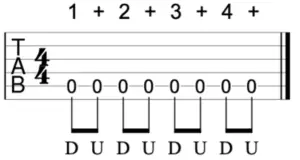
For an eighth-note pulse, every beat gets divided into two equal parts. You count it as 1 + 2 + 3 + 4 +, and your hand alternates Down Up Down Up Down Up Down Up. Your foot taps on every downstroke.
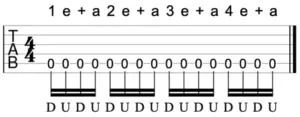
For a sixteenth-note pulse, each beat gets divided into four equal parts: 1 e + a 2 e + a 3 e + a 4 e + a. That’s four hand motions per foot tap — Down Up Down Up within each beat.
The key is the word “miss.” When a strumming pattern calls for you to skip a strum, your hand still moves — it just doesn’t hit the strings. So instead of saying “down” or “up,” you say “miss.” Your hand keeps swinging. The pendulum doesn’t stop.
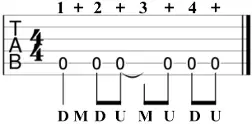
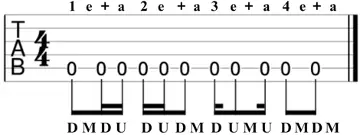
For this 16th note pattern, maintain a steady up and down hand movement with four motions per beat and say:
The Practice Method That Works
Talk your hand through it. Seriously — say the words out loud as you strum.
For a pattern where you skip an upstroke, you’d say: “Down, miss, down, up, miss, up, down, up.” Your hand moves on every syllable. You hit the strings on “down” and “up.” You swing right past them on “miss.”
Start without a metronome. Get the motions feeling natural first. Once your hand is maintaining that steady swing, add a metronome at around 50–60 BPM and build from there.
One more tip that makes a big difference — practice with muted strings. Just lay your fretting hand lightly across the strings so nothing rings out. This lets you focus entirely on your strumming hand without worrying about chord changes. Get the right hand locked in first. Everything else builds on top of it.
This Is the Foundation
I’ve been teaching for over thirty years, and I can tell you that the pendulum strum is one of the most important skills you’ll ever develop as a guitarist. It’s the foundation that rhythm, strumming patterns, and even your ability to sing and play at the same time are all built on.
And here’s the encouraging part — it’s absolutely learnable. It doesn’t require special talent. It requires understanding the concept, committing to the practice method, and actually doing the work the same way between lessons that you do during lessons. Do that, and you’ll get it. Tom did. And so do the overwhelming majority of students I work with.
If your strumming has always felt off, or everything you play sounds the same and you’ve never been able to figure out why — this is probably it. And once you fix it, you’ll wonder how you ever played without it.

About The Author
Brian Fish is a professional guitarist who has been dedicated to helping other guitar players in Northeast Ohio pursue their musical dreams since 1994. He’s passionate about guiding others on their musical journey! He is the Guitar Playing Transformation Specialist, instructor, mentor, trainer, and coach at Guitar Lessons Geauga.
Brian has also assisted people from around the globe in developing a solid sense of timing and enhancing their creativity through the fantastic rhythm course, “Ultimate Rhythm Mastery,” available at MusicTheoryForGuitar.com.
If you live in Geauga County / North East Ohio, Guitar Lessons Geauga can help you become the player you’ve always wanted to be.