
The Honest Answer Nobody Wants to Hear
I get this question at least once a week. Sometimes from a parent calling about lessons for their kid. Sometimes from a 45-year-old who’s been thinking about picking up guitar for twenty years and finally decided to do something about it. And sometimes from a 65-year-old who just retired and is wondering if it’s too late to start something they’ve always wanted to do.
And every time, I give the same answer that nobody wants to hear:
It depends.
I know. You wanted a number. Three months. Six months. A year. Something you could circle on a calendar and say, “That’s the day I’ll be able to play.”
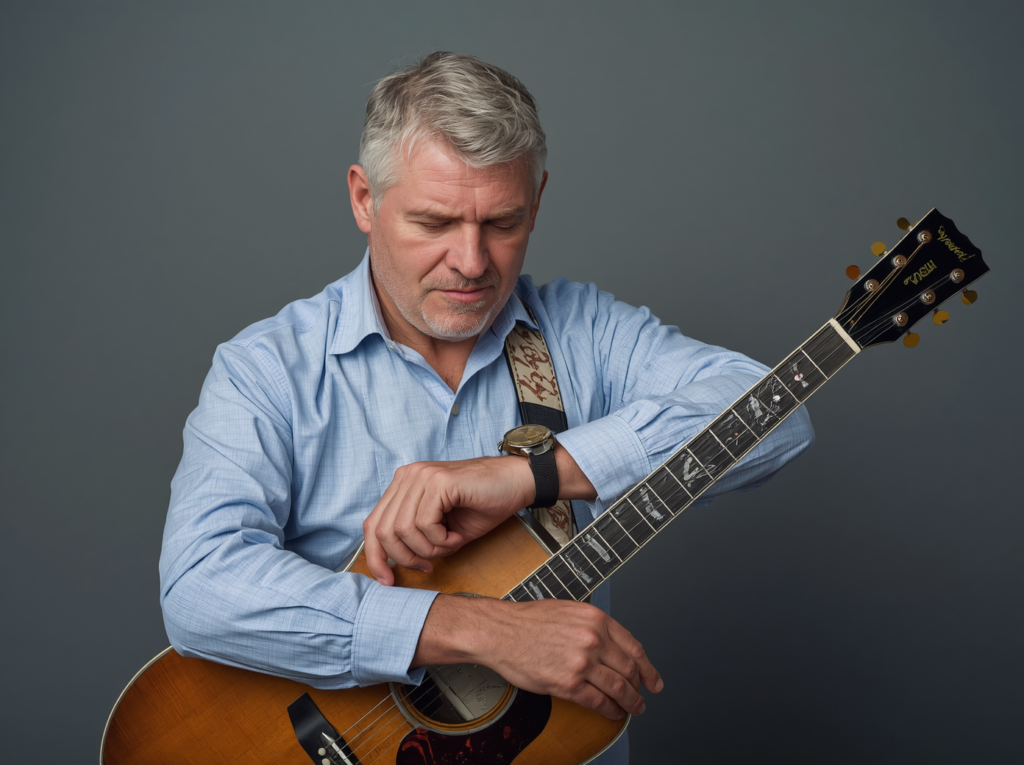
But here’s the thing — after 30+ years of teaching guitar in Newbury, located in Northeast Ohio, I’ve watched students progress at wildly different speeds. And the difference almost never comes down to “talent.”
The Question Behind the Question
When someone asks “how long does it take,” what they’re really asking is: “Is this going to be worth it? Am I going to waste my time and money and end up quitting like I did last time?”
That’s the real fear. And it’s a legitimate one.
Most people who try to learn guitar quit. That’s not a scare tactic — it’s an observation I’ve made over three decades. The guitar industry sells you a dream, and then it hands you an app or an online course and leaves you alone in a room watching endless YouTube videos with sore fingers, wondering why you can’t play that song or play a simple blues solo yet.
So let me reframe the question. Instead of “how long does it take,” the better question is: “What’s actually going to determine whether I succeed or fail?”
Now we’re getting somewhere.
The Three Things That Actually Control Your Timeline
1 What “learning guitar” means to you.
This is the first thing I ask anyone who calls me. What do you actually want to be able to do?
If you want to strum some simple songs or play basic melodies — the kind of thing where you’re sitting on the couch playing for yourself — you can reach those goals pretty fast. We’re talking months, not years.
If you want to play in a cover band or perform as a solo act at local venues, that’s going to take longer. You need more skills, more repertoire, and the confidence to perform in front of people. But it’s absolutely doable.
If you want to play at a professional level — be a studio musician, join a touring act, make a real go of it — that’s a bigger commitment. More time, more depth, more refinement.
Here’s the point: every single one of those goals is reachable. And you will reach all of them much faster when you work with and train under a professional teacher who has helped other people just like you get there.
2 How you practice — and whether you follow direction.
This is where most people go sideways, and it’s where most guitar teachers fail their students.
I’ve had students come to me after years of lessons somewhere else, and they’re still struggling with basic things. Not because they’re slow learners. Because nobody taught them how to practice correctly. They were just told “practice this song” and sent home.
That’s like telling someone to “get in shape” without showing them a single exercise, a rep count, or explaining why form matters. You wouldn’t train for a marathon by just “going for runs.” You’d follow a program. Guitar is no different.
I train my students. Specific skills, in a specific order, with specific methods. And here’s the part where I’m going to be blunt: the students who progress fastest are the ones who follow the direction I give them and don’t go searching for random things on YouTube between lessons.
I get it. You see a video of someone playing something cool and you want to learn that right now. But every time you chase a shiny object on the internet, you’re stepping off the path. And every side road you explore is time you’re not spending moving toward your actual goal.
There are many ways to become a good guitar player. But personally, I want to find the fastest way to get you there — and that’s always working with an experienced instructor who has a track record of getting results. I’m not interested in the scenic route, and you shouldn’t be either. The scenic route is bouncing between random resources with no clear plan, no accountability, and no one to tell you when you’re headed in the wrong direction.
3 Whether someone is correcting your mistakes in real time.
This is the big one. And it’s the reason YouTube, apps, and online courses will only take you so far.
Here’s what most people don’t realize: when you’re learning guitar, you don’t have the experience to recognize what you’re doing wrong. You can’t see your own left hand from the angle that matters. You can’t hear the subtle buzzing that’s becoming a bad habit. You can’t feel the tension in your palm or shoulder that’s going to cause problems six months from now. You don’t know what you don’t know.
A good teacher catches those things in the moment and fixes them before they become permanent. That immediate correction is the single biggest accelerator of progress I’ve seen in three decades of teaching. It’s not even close.
And this is why my lessons are structured differently than what most people expect. My students aren’t just sitting there being fed information for thirty minutes. They’re practicing and training in the lesson — actually playing, actually working through skills — while I watch, correct, and guide in real time. Most lesson formats are basically a teacher talking at you and sending you home with an assignment. That’s not training. That’s a lecture. When you’re training in the lesson, every rep counts because I’m there to catch the mistake before it becomes a habit. You walk out of my studio having already improved — not just hoping you understood the homework well enough to improve on your own.
What About Apps and Online Courses?
Let me save you some time and money.
Apps and online courses are great at one thing: giving you information. They can show you where to put your fingers. They can play a song slowly so you can try to follow along. Some of them are genuinely well-made.
But information is not instruction.
Information is knowing what a barre chord is. Instruction is someone watching you try to play one and telling you exactly why it’s not ringing out and how to fix it — right now, in this moment, before you practice it wrong 500 more times.
The internet has convinced people that access to information is the same as learning. It’s not. Knowing about something and actually being able to use it are two different things. If information was all you needed, everyone sitting at home watching YouTube videos about guitar would be a great guitar player. And we both know that’s not the case.
Apps and courses can’t hear you play. They can’t see your hand position. They can’t tell you that the reason your chord changes are slow is because your thumb is in the wrong spot on the back of the neck. They give you the what. A good teacher gives you the why and the how — customized to you, in real time.
Some Real-World Timelines
Alright, I know you still want some kind of number. So here’s what I’ve actually seen with students who show up consistently and follow the program.
Many of my students are already playing at open mic nights within a few months. Not years. Months. They’re not shredding solos — but they’re up on stage, performing, and having the time of their lives. That’s not an exaggeration. That’s what happens when you build real skills from day one instead of fumbling around with random tutorials.
One of my students, Emily, was playing all the local musicians’ nights within a year. She’s got a great voice, and people love to hear her perform. She didn’t get there by watching videos. She got there because she had a clear path, she trusted the process, and she stayed on it.
Then there’s Elliot. Elliot came to me knowing one song. Sort of. Within a few years, he’s playing in multiple bands, playing at his church, and is now planning to move to Nashville to pursue music professionally. From barely knowing one song to Nashville-ready. That’s what proper training looks like.
You know what Emily and Elliot have in common? They did what I told them to do. They didn’t second-guess the program. They didn’t disappear down YouTube rabbit holes between lessons looking for shortcuts. They followed the plan, put in the work, and let the results speak for themselves.
But here’s what really sets my students apart from most guitar players: they don’t just learn songs. They learn how to create their own parts that fit — so they can sit in with other musicians and actually contribute something. They can jam. They can listen to what’s happening around them and play something that works. And some take it even further and start writing their own music. Students like Dan, George, and Jonah have gone on to release their own CDs — some of them more than one. That doesn’t happen when all you’ve learned is how to copy someone else’s songs off the internet.
That’s the difference between being a musician and being someone who can play a few things on the guitar. And that skill is what makes you the person people want to play with.
The Uncomfortable Truth About “Self-Taught”
I’m not going to tell you it’s impossible to learn guitar on your own. Some people do. But here’s what I will tell you: in 30+ years of teaching, nearly every “self-taught” guitarist who’s walked through my door has had significant gaps and bad habits that took months to undo.
Months. Not weeks. Months of unlearning things they thought were correct.
That distinction — between having information and being properly trained — is the difference between learning guitar in a reasonable timeframe and spending years spinning your wheels.
So How Long Will It Take You?
That’s up to you. But I can tell you the factors that will determine your answer.
If you have clear goals, a structured approach, consistent practice habits, and someone experienced correcting your course along the way — you’re going to be shocked at how fast you progress.
If you’re cobbling together random YouTube videos, bouncing between apps, and hoping it all comes together somehow — you will probably be asking this same question a year from now with no real progress to show for all the effort you’ve put in.
The guitar doesn’t care how long you’ve been holding it. It cares whether you’ve been building real skills or just going through the motions.
If you’re serious about learning guitar and you don’t want to waste time figuring it out the hard way, Click the button below to schedule a FREE TRIAL LESSON. I’ll give you an honest assessment of where you are and what it’s going to take to get where you want to go. No pressure, no sales pitch — just a straight conversation between you and someone who’s been doing this a very long time.

About The Author
Brian Fish is a professional guitarist who has been dedicated to helping other guitar players in Northeast Ohio pursue their musical dreams since 1994. He’s passionate about guiding others on their musical journey! He is the Guitar Playing Transformation Specialist, instructor, mentor, trainer, and coach at
Guitar Lessons Geauga.
Brian has also assisted people from around the globe in developing a solid sense of timing and enhancing their creativity through the fantastic rhythm course, “Ultimate Rhythm Mastery,” available at MusicTheoryForGuitar.com.
If you live in Geauga County / North East Ohio, Guitar Lessons Geauga can help you become the player you’ve always wanted to be.