
You can. I did. And I’m going to be honest about what that actually looked like — the parts that worked and the parts that cost me years.
I’ve been playing guitar for over 40 years and teaching for over 30. Before I found the right teacher, I spent a long stretch trying to teach myself. I learned things during that time that I still use today. I’m not going to tell you self-teaching is worthless, because for me it wasn’t.
But I am going to tell you what it actually costs — not in dollars, but in time, confusion, and habits you don’t realize you’re building until someone finally points them out.
What Self-Teaching Actually Looked Like for Me
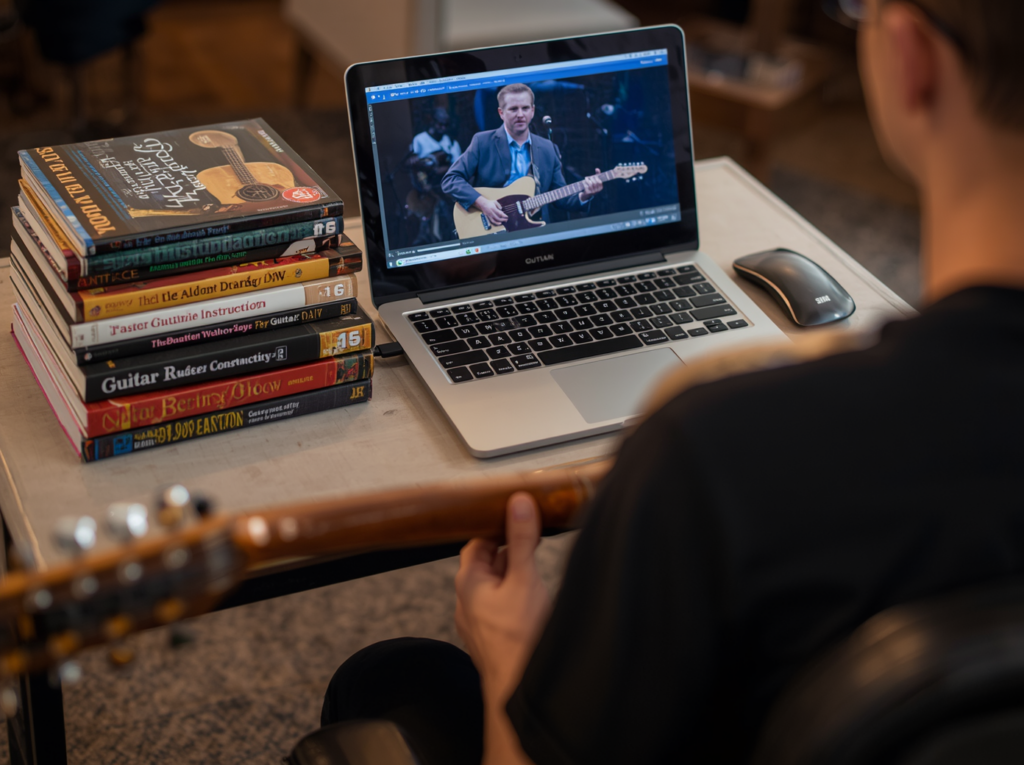
I started learning from guitar columns in Guitar for the Practicing Musician and later Guitar World, picking things up by ear, working through whatever I could find. At the time, this was a godsend — it was information I’d never had access to before. But it was also too much, and I didn’t know enough to know what was important for me and what was not. So I worked on a little bit of everything.
Over the years, I spent thousands of dollars on magazines, VHS tapes, and DVDs trying to teach myself, and wasted more hours than I can count on material that never helped me play what I actually wanted to play.
Did I learn things? Yes. Can I point to specific skills from that period that are still in my playing? Absolutely. But for every useful thing I practiced, I spent just as much time — probably more — practicing things I have never used or were not important for what I wanted to play. In 30-plus years of playing and teaching, some of that material has never come up.
The Real Problem With Teaching Yourself
The issue isn’t that you can’t learn anything on your own. You can. The issue is you have no way to evaluate what you’re learning. You don’t know what’s worth your time and what isn’t. You don’t know if you’re practicing the right things in the wrong order, or the wrong things entirely. There’s nobody filtering for you.
So you practice everything with equal effort and hope it all pays off eventually. Some of it does. A lot of it doesn’t. And you won’t know which is which until years later — if you stick with it long enough and gain enough experience to start telling what’s important and what’s not. That’s slightly different for every style of music, which makes it even harder to sort out on your own.
Today It's YouTube. The Problem Is the Same.
Back when I was learning, the information came from magazines and videos you bought through the mail. Today it’s YouTube. The format changed. The problem didn’t.
Here’s what I see when students come to me after a year or two of learning from YouTube: they can play pieces of things they’ve been shown, but they don’t understand why any of it works. It’s imitation without comprehension — they watched someone do it, they copied the finger movements, and that’s where it stopped.
The bigger issue is the students who’ve been watching multiple YouTube teachers. Each one has a different approach, different terminology, sometimes contradicting each other directly. These students don’t come in with bad habits from one source. They come in with a complete misunderstanding of how things fit together, because they’ve been assembling a puzzle with pieces from five different boxes. It’s way more confusing than it needs to be, and untangling that confusion takes longer than starting from scratch would have.
Even Advanced Players Struggle With YouTube Instruction
A few years ago, I wanted to learn country lead guitar. I couldn’t find anyone locally who taught it, so I tried working with one of the big-name players and teachers on YouTube for about a year. I thought it would be a shortcut to get into the style quickly.
It wasn’t.
This is a guy I respect — a serious player. But as instruction, it was disappointing. You send him a video of your playing, he responds with a video of his playing — lots of impressive playing, very little actual explanation, all at a high level. It looks amazing. As teaching? Not really.
If you played guitar in the ’80s, you probably remember the infamous Yngwie Malmsteen instruction video — the one where he plays a lick at full speed, says “now here it is a little slower,” and plays it at the exact same speed. This was basically that. Most great players have not developed the skills it takes to teach. Playing and teaching are separate skills that both take a lot of practice and experience.
I have over 30 years of experience, a solid theory background, and the ability to transcribe and analyze what I’m hearing. If anyone should be able to make YouTube instruction work, it’s me. And after a year, I didn’t come away with nearly enough to justify what I paid. I did learn some things, but it was like pulling teeth.
I ended up doing it the old-fashioned way — transcribing a bunch of country lead parts and figuring out my own approach. Now when I watch live video, what I see and hear makes sense. But that was a lot of work, and it only worked because I already had decades of foundation to build on.
A beginner watching that same player has no chance of extracting anything useful. They don’t have the foundation to understand what they’re seeing. They just see fast fingers and think, “I could never do that” — or worse, they try to copy it and build habits that will take months to undo.
What You Build When Nobody's Watching
The other thing self-taught players don’t realize is what they’re building when nobody’s correcting them. Bad habits in your technique feel normal because you’ve never known anything different. A grip that limits your speed, poor strumming technique that makes it way harder to keep time than it needs to be, a fretting hand position that guarantees buzzing — you can practice these for years and never know there’s a problem because the problem is all you’ve ever known.
I see this in almost every self-taught student who walks through my door. The fix is usually simple — sometimes it’s something we correct in the first lesson. But they’ve been fighting that problem for months or years without knowing it existed.
So Can You Teach Yourself Guitar?
You can learn things on your own. I’m proof of that. But there’s a difference between picking up scattered skills over years of trial and error and actually progressing as a player in a way that’s efficient and builds on itself.
I spent thousands of dollars and years of practice time teaching myself. When I finally found the right teacher in my 30s, I improved faster in months than I had in the entire previous decade. Not because I wasn’t talented or wasn’t trying. Because someone finally showed me what to focus on, what to ignore, and how to practice what actually mattered.
I’ve had students who want to play at a professional level reach that in a few years — something that took me well over a decade. The difference? They follow directions and do what I tell them to do. They don’t waste years sorting it out on their own like I did. If you’re playing for your own enjoyment, you’ll get there even faster.
You can teach yourself guitar the way I did. You’ll learn some things. You’ll waste time on others. You’ll build habits you don’t know are holding you back. And years from now, you might find a teacher who fixes in a few weeks what you’ve been stuck on all along.
Or you can skip that part and start with the right instruction now.
Ready to stop wasting time? Book a free trial lesson — you’ll walk out playing better than when you walked in. Guaranteed.
About The Author
Brian Fish is a professional guitarist who has been dedicated to helping other guitar players in Northeast Ohio pursue their musical dreams since 1994. He’s passionate about guiding others on their musical journey! He is the Guitar Playing Transformation Specialist, instructor, mentor, trainer, and coach at
Guitar Lessons Geauga.
Brian has also assisted people from around the globe in developing a solid sense of timing and enhancing their creativity through the fantastic rhythm course, “Ultimate Rhythm Mastery,” available at MusicTheoryForGuitar.com.
If you live in Geauga County / North East Ohio, Guitar Lessons Geauga can help you become the player you’ve always wanted to be.