
Choosing a guitar teacher is one of those decisions that can shape how your child feels about music—and themselves—for years to come.
Pick the right teacher, and your child gains confidence, creativity, and a lifelong love of playing guitar.
Pick the wrong one, and they could walk away frustrated, unmotivated, and convinced they “just aren’t musical.”
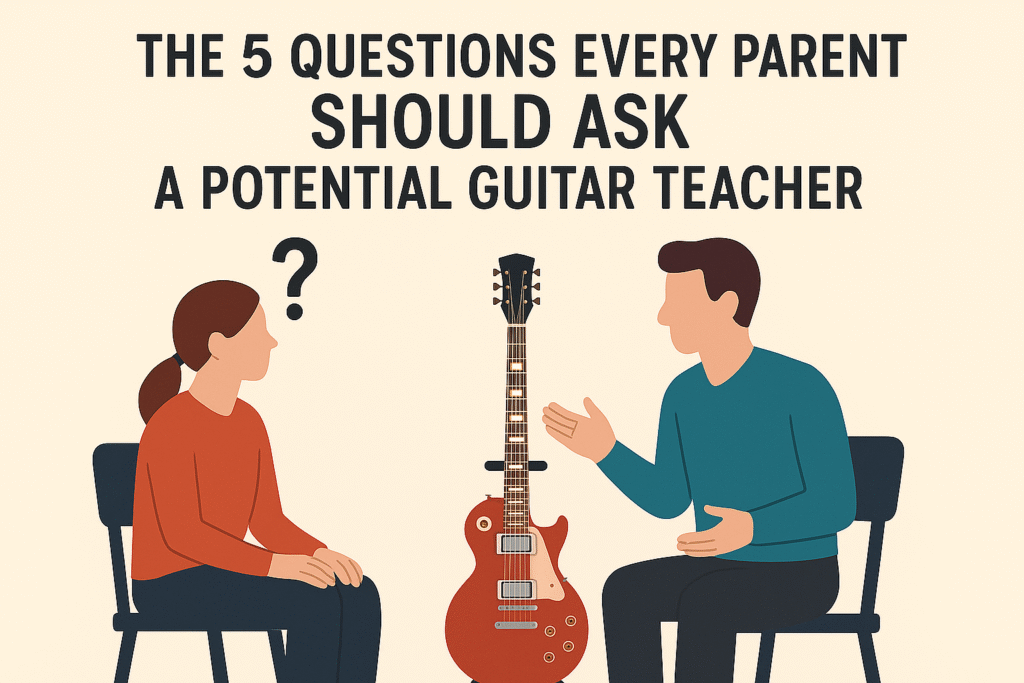
The right teacher can unlock confidence and creativity in your child; the wrong one can shut the door on music before it even opens.
That’s why this isn’t a casual decision to take lightly. To make sure you’re putting your child in the best hands, here are five questions every parent should ask a potential guitar teacher—and what the answers reveal.
1. "What kind of training do you have in teaching kids?"
A lot of guitar teachers are players who decided to start teaching. They might be talented musicians—but knowing how to entertain around a campfire, play in a band, or lead worship on Sundays doesn’t mean they know how to work with a 10-year-old who’s never held a guitar.
Teaching is its own skill set. It’s understanding how people learn, how to break complex movements into steps a kid can actually execute, and how to keep them engaged when something gets hard.
I’ve been teaching since 1994, and early on I learned that playing ability and teaching ability are completely different things. Here’s the problem: a player who picks up teaching is trying to teach from their current level. They haven’t had to think like a beginner in a long time. The things they’re showing your child are easy and automatic for them, so when the kid can’t do it, the teacher gets frustrated with the student’s inability instead of realizing they need to simplify. They need to find the right layer of difficulty—something the student can actually execute right now, not something the teacher can execute after twenty years of playing. Thinking in layers like that isn’t common, and it takes real time and practice to understand and master. Most players who start teaching have never even considered it.
When you ask this question, listen for specifics.
What to look for: A teacher who isn’t just a player, but someone trained in how to teach effectively—and with real experience working with kids. They should be able to explain not only how they help students succeed, but also how they adapt their approach to fit the needs of each child.
2. "How do you keep students motivated when things get hard?"
Every child hits a wall. Maybe it’s a chord change that won’t come together, maybe it’s frustration over practicing, or maybe they just don’t feel like they’re making progress. That moment—right there—is where most kids quit. And it’s where the teacher matters most.
I had a student named Aiden. Socially awkward kid. Guitar did not come easy for him—not even a little. There were plenty of points where a different teacher might have had the talk with his parents that this just isn’t for him. But he really loved music and liked the idea of playing guitar. And sometimes all it takes is someone who believes you can do this and actually tells you that.
With Aiden, the key was finding the right layer for him to work on at any given time—something he could play successfully, something that sounded like real music, something that let him feel like he belonged in the room. Early on, that might have been a simple two-note part that fit underneath what the other students were playing. It wasn’t flashy, but it was his, and he could hear how it locked in with everyone else. That’s where confidence starts.
It took a while. But over time, Aiden ended up playing some fairly difficult pieces. He never joined a band—he was doing it for himself. And that’s perfectly fine. What he gained was confidence, not just in guitar, but in himself. That’s the kind of result that doesn’t show up on a checklist, but it’s the one parents tell me about years later.
That’s what I mean by layering. Every student always has something they can play—something that sounds good and contributes to the music—regardless of where they are technically. Beginners might play a simple rhythm or a one-note bass line. More advanced students layer on melodies or complex rhythms on top. Nobody sits on the sideline watching other people play. That’s what keeps kids coming back.
What to look for: If a teacher can’t explain how they’ll help your child push through the inevitable tough spots, your child is at risk of losing interest when the first challenges hit.
3. "What's your actual plan for teaching my child?"
Some teachers sit down each week and ask, “So what do you want to learn?” That might sound fun and flexible, but what it usually produces is a kid who knows random bits and pieces—a riff here, a chord there—without any of it connecting into real ability. After six months, they can’t play a complete song or play alongside another musician, which is the entire point of picking up an instrument.
Here’s what a real plan looks like: from the very first lesson, I’m teaching proper technique—how to hold the guitar, how to position the left hand, how to strum cleanly. These aren’t boring prerequisites I rush through to get to the fun stuff. They are the fun stuff, because a student who starts with good fundamentals progresses faster than one who has to go back later and unlearn bad habits.
From there, every student works through a sequence that builds real skills in a specific order—chords, rhythm, reading chord charts and lead sheets, scales—with each new skill layered on top of the last. But the sequence isn’t rigid. I meet with both the parent and the child, assess where the student is, learn what kind of music they’re excited about, and map those core skills to songs they actually want to play. The structure is the same. The path through it is personalized.
What to look for: A good teacher doesn’t hand out a cookie-cutter plan. Instead, they take time to meet with both the child and the parent, assess current abilities, and learn about the student’s goals. Yes, the core skills are important for everyone, but learning the right things in the right order makes all the difference. An experienced teacher knows how to match those skills to a child’s interests and learning pace so the student feels challenged, encouraged, and always moving forward.
4. "What's your experience with kids like mine?"
Anyone can hang a shingle and start teaching guitar tomorrow. But when you’re trusting someone with your child’s time, confidence, and interest in music, experience matters.
In thirty-plus years, I’ve worked with hundreds of kids. I’ve seen the shy ones who won’t make eye contact for the first month. The high-energy ones who want to jump ahead before they’ve learned the basics. The perfectionists who get upset when they can’t play something perfectly the first time. The ones whose parents say “he doesn’t like to practice.”
Joel from Chesterland was a perfectionist. If he made a mistake during a lesson, he’d stop and start over from the beginning—every time. He wasn’t going to get anywhere doing that, so I tried something different. I started pulling out records from the ’70s and we’d listen together. Really listen. And what Joel started to hear surprised him.
These are some of the most famous recordings of all time, played by world-class professionals. And they have imperfections. A little string noise. A bend that isn’t quite perfect. A song that speeds up just slightly—not a lot, but enough if you’re paying attention. These are the records that made these musicians legends, and they’re not flawless. That’s part of what makes them great. It’s the human element—the thing that’s mostly missing from today’s music, where you can fix everything on a computer.
Once Joel heard that, the question became obvious: if these songs are famous and these musicians are famous, why do I have to be perfect at this point in my playing? He finally got it—the pros make mistakes too. They’re just really good at making them blend in. They keep going and play the rest of the piece to the best of their ability. That’s what every musician who plays live learns to do, and it’s one of the most important things a perfectionist can learn on guitar.
When you ask this question, you’re not looking for the number of kids they have taught.
What to look for: You’re not looking for the number of kids they have taught. You’re looking for whether the teacher can describe specific types of kids they’ve worked with and what they did differently for each one. If every kid gets the same approach, it’s not teaching—it’s a script.
5. "What kind of results should I expect—and when?"
This might be the most important question. Parents don’t just want lessons. They want to know their child will make progress they can actually see.
A good teacher won’t promise your child will be a rock star in six months. But they should be able to tell you what realistic progress looks like in the first few weeks and months—switching between chords with confidence, strumming along with real songs, playing their part alongside other musicians.
It’s worth knowing that progress isn’t always a straight line. Some kids pick things up fast early and then plateau. Others struggle at first but develop something deeper—a persistence and attention to detail that makes them stronger players in the long run. In my experience, the kids who have to work a little harder at the beginning are often the ones who stick with guitar for life.
And for some kids, especially early on, the biggest result is simply this: they look forward to coming back. That excitement is what builds consistency, and consistency is what builds musicians.
The Bottom Line
When you’re choosing a guitar teacher, you’re not just buying lessons—you’re investing in your child’s confidence, creativity, and enjoyment of music. The teacher you choose will shape whether guitar becomes something your child sticks with and loves, or something they give up on too soon.
Ask these five questions, and you’ll quickly see which teachers have a real plan for your child and which ones are winging it. The right teacher brings professional training, a proven system, the ability to keep kids engaged through both boredom and frustration, and the experience to adapt to your child’s specific needs and pace.
If you’re looking for that kind of instruction in Northeast Ohio, that’s exactly what we do at Guitar Lessons Geauga in Newbury, Ohio. Lessons are designed to build real skills from day one—and to keep your child excited about playing for years to come.

About The Author
Brian Fish is a professional guitarist who has been dedicated to helping other guitar players in Northeast Ohio pursue their musical dreams since 1994. He’s passionate about guiding others on their musical journey! He is the Guitar Playing Transformation Specialist, instructor, mentor, trainer, and coach at
Guitar Lessons Geauga.
Brian has also assisted people from around the globe in developing a solid sense of timing and enhancing their creativity through the fantastic rhythm course, “Ultimate Rhythm Mastery,” available at MusicTheoryForGuitar.com.
If you live in Geauga County / North East Ohio, Guitar Lessons Geauga can help you become the player you’ve always wanted to be.