
Here’s something that comes up in almost every conversation I have with new students — or their parents.
“Shouldn’t we start with reading music?”
I get it. If you took guitar lessons in the ’70s or ’80s, that’s probably how it went. You sat in a chair, squinted at a staff, and plucked out “Mary Had a Little Lamb” one painful note at a time. So naturally, you’d expect lessons to work the same way now.
And if you’re a parent who watched your kid learn piano, it makes even more sense. Piano lessons start with reading notes off a staff. That’s the standard. Why would guitar be different?
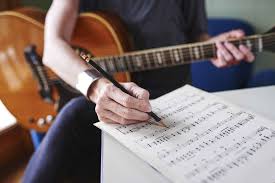
Here’s why: Guitar is different. Fundamentally different.
A piano has one middle C. Press that key, you get that note. Simple. One keyboard, one layout, every note in one place.
Playing guitar is like playing six keyboards simultaneously — all starting on different notes. A guitar has five middle C’s — four if you’re playing an acoustic without a cutaway. The same pitch lives in multiple places on the neck, each with a different tone and feel. That one detail changes everything about how the instrument should be taught.
On piano, the staff is basically a map of the keyboard — each note on the page points to exactly one key. On guitar, each note on the page could mean five or six different locations on the neck. It’s the slowest, most frustrating way to get started on an instrument that doesn’t work like a piano in the first place.
Over 30 years, I’ve heard the same story from students again and again. Their previous teacher spent months drilling note reading instead of teaching them to actually play guitar. They got frustrated, bored, and discouraged. The guitar ended up in the closet.
That’s not how you learn an instrument.
So let me be direct about when you actually need standard notation, when you’re wasting your time on it, and what to do instead.
When You DON'T Need Standard Notation
If You’re Just Starting Out
Beginners shouldn’t touch standard notation. Period.
Your focus should be on learning basic chords, understanding chord charts, and practicing simple rhythms. These are the foundational skills you’ll use in almost every style of music.
For melodies or riffs, learn short manageable pieces by ear, from tablature, or from a teacher who can show you exactly where your fingers go.
This approach lets you play actual music quickly. Music you’re excited about. Music that keeps you coming back to practice.
Spending your first months plucking out nursery rhymes in the first three frets when you want to be playing something that actually sounds like music? That’s a recipe for quitting.
I’ll be honest — I did this myself in my first few years of teaching. Method books, reading from the staff, the whole thing. Everyone else taught that way, so it must be the right way. I didn’t give it more thought than that. Until I started asking two questions: When does a guitar player actually use this skill? And is there a better way to get people playing quickly, having fun, and learning the skills they’ll need in most situations? The answer to both changed how I teach.
I should have known better. I started guitar at age seven — a neighbor who played gave me lessons. We worked out of a book. I hated it and quit. I tried again at nine with a different local teacher. Same approach, same result. And the thing is, I loved music. I always had the radio on. I had 8-tracks and records at a young age — AC/DC, The Bee Gees, Queen, Foreigner, Toto. But the stuff I was learning sounded nothing like the music I wanted to play.
At thirteen, I found a magazine — Guitar for the Practicing Musician. It had music for songs I actually wanted to learn, written in tablature. I struggled my way through figuring out how to read tab, and luckily, it clicked. I was off. My next formal teacher wasn’t until college.
So how did I end up teaching from a book myself? When I got my first teaching opportunity, the guy who hired me wanted to see how well I could read music before giving me the job. I’d always felt a little guilty about never finishing those beginner books I had as a kid — they said “beginner” right on the cover, and I never got through them. So over the years, I begrudgingly worked on my reading in between playing the things I actually liked. But that audition reinforced the idea — reading must be what matters, so that’s how you teach. It took a few years of watching students lose interest before I had the confidence to question that assumption.
If You’re a Hobbyist Playing for Fun
If your goal is playing for yourself, your family, or friends around a campfire — standard notation isn’t going to be part of the picture.
Most hobbyist guitarists learn songs by ear, from a teacher, or from simple chord charts with lyrics. These resources are everywhere and easy to use.
You can play hundreds of songs without ever reading a note off a staff. Your time is better spent building a repertoire you enjoy and getting smooth at chord transitions. That’s what actually makes you sound good at the campfire.
If You’re in a Cover Band or Original Band
If you’re playing in a band that does cover songs or original music, reading standard notation usually isn’t part of the job.
These bands work from setlists. You rehearse songs until everyone’s memorized their parts. During the learning phase you might use chord charts or tabs as reference, but performances are from memory.
Your key skills: learning songs quickly, locking in with other musicians, improvising when needed. None of that requires reading standard notation.
I’ve had students play in successful local bands for years without ever learning to read music. It just doesn’t come up.
When You SHOULD Learn Standard Notation
If You’re Playing All-Occasion Bands
All-occasion bands are a different world. Weddings, corporate events, parties — these gigs require you to play different setlists constantly.
These bands have a huge song list and a book of charts. You need to be able to open that book on the gig and play what’s in front of you — sight-reading on stage, in real time.
In this setting, reading becomes essential. You need to sight-read chord symbols and rhythms, play single-note lines on the spot, follow detailed arrangements, and improvise tastefully when the chart calls for it.
The music ranges from pop and rock to jazz standards to theater-style arrangements. Jazz-influenced bands especially use complex harmonies and detailed charts.
I went to college with a guy who loves this world. He plays in a wedding band, wears a tux to every gig — something I personally can’t stand — and he plays jazz every chance he gets. For him, reading is a skill he uses all the time. He’s the exception, and he knows it.
Without solid reading skills, you can’t do these gigs. But if you’re not pursuing this path, don’t waste time on it.
If You’re Playing in Theater Bands
Playing in a theater production is another scenario where reading is non-negotiable.
Whether it’s a musical, pit orchestra, or school theater band, you’re working from detailed charts. Chord symbols, rhythms, single-note lines — you play exactly what’s written, every performance.
The music tends to be more intricate than typical cover band material. You need precise reading skills, the ability to follow a conductor, and a strong sense of dynamics.
This is specialized work. If you’re interested in it, learn to read. If not, skip it.
If You’re Writing or Arranging for Other Musicians
If you want to compose or arrange music for ensembles, you need to read and write standard notation.
Tablature works for guitar. But horn players, string players, pianists — they all use standard notation. If you’re writing parts for them, you need to speak their language.
This opens opportunities to work with diverse musicians and bring your creative ideas to life. But again — this is specialized. Don’t learn it unless you’re actually pursuing this type of work.
The Smart Way to Learn It (When You Actually Need It)
Here’s where most guitar instruction gets things backwards — literally.
On piano, you learn to read the staff first, then you know where the notes are. That makes sense because each note lives in one place on the keyboard.
On guitar — “six keyboards”, all starting on different notes — that approach sets you up for frustration. You work through the method book, learn all the notes in the first five frets, and think you’re done. Then you find out those same notes exist in other positions on the neck, and you need to do that work all over again. And again.
What actually works is learning it backwards.
Step one: Learn the note names on the neck. Before you ever look at a staff, know where every note lives on your fretboard. This is useful for every guitarist regardless of whether you ever read notation — it helps you understand chords, communicate with other musicians, and navigate the instrument with intention instead of just memorizing finger shapes or tablature.
Step two: Learn to decode the staff separately. Away from the guitar, learn what each line and space represents. Practice writing the letter name above each note. Do this until it feels automatic — until you can glance at a note on the staff and immediately know its name without counting lines.
Step three: Put it together. By now you’ve learned scale shapes and you know the staff. Connecting note names to those patterns is far easier than starting from scratch in each position. You see a note, you know its name, you already know where it lives on the fretboard. The connection is natural instead of forced.
For most people, step one is valuable no matter what. Steps two and three are only worth your time if your goals actually require reading — all-occasion bands, theater work, composing, or arranging.
The Reality Most Teachers Won't Tell You
Here’s what I’ve observed over 30 years:
The vast majority of guitar players never need to read standard notation.
They learn by ear. They use tabs. They follow chord charts. They memorize their parts. And they’re successful. They play in bands. They perform. They enjoy music. They’re good players.
Reading notation doesn’t make you a better guitarist. It makes you a guitarist who can read notation. Those are different skills.
I’ve seen amazing players who can’t read a note. I’ve seen players who read perfectly but sound terrible because they never developed their ear or their feel.
What I Tell My Students
Learn notation if and when you need it for specific goals. Not because someone says you should. Not because “that’s the way it’s always been done.”
That outdated approach is why so many guitars end up in closets instead of being played.
Your time is valuable. Your motivation matters. If spending months on note reading drills kills your excitement for guitar, you’ve made the wrong choice — even if reading is theoretically “valuable.”
Better to become a competent player who can’t read notation than someone who can read perfectly but end up quitting because you never got to play something fun.
A good teacher helps you prioritize the right skills for your actual goals. That’s what I do — we don’t touch notation until a student’s goals specifically require it. And when we do, we build toward it in the right order so it actually makes sense on this instrument.
Focus on playing music you love. Build practical skills. Develop your ear. Get good at the instrument.
If your goals eventually require reading notation, you’ll learn it then — with context and motivation for why it matters.
That’s the approach that actually keeps people playing for years.

About The Author
Brian Fish is a professional guitarist who has been dedicated to helping other guitar players in Northeast Ohio pursue their musical dreams since 1994. He’s passionate about guiding others on their musical journey! He is the Guitar Playing Transformation Specialist, instructor, mentor, trainer, and coach at
Guitar Lessons Geauga.
Brian has also assisted people from around the globe in developing a solid sense of timing and enhancing their creativity through the fantastic rhythm course, “Ultimate Rhythm Mastery,” available at MusicTheoryForGuitar.com.
If you live in Geauga County / North East Ohio, Guitar Lessons Geauga can help you become the player you’ve always wanted to be.