Here’s what most parents don’t realize about kids and guitar lessons:
Most kids quit.
They start excited. Maybe they stick with it for a few months. Then practice becomes a battle. Progress stalls. Motivation fades. Eventually, the guitar sits in the corner gathering dust.
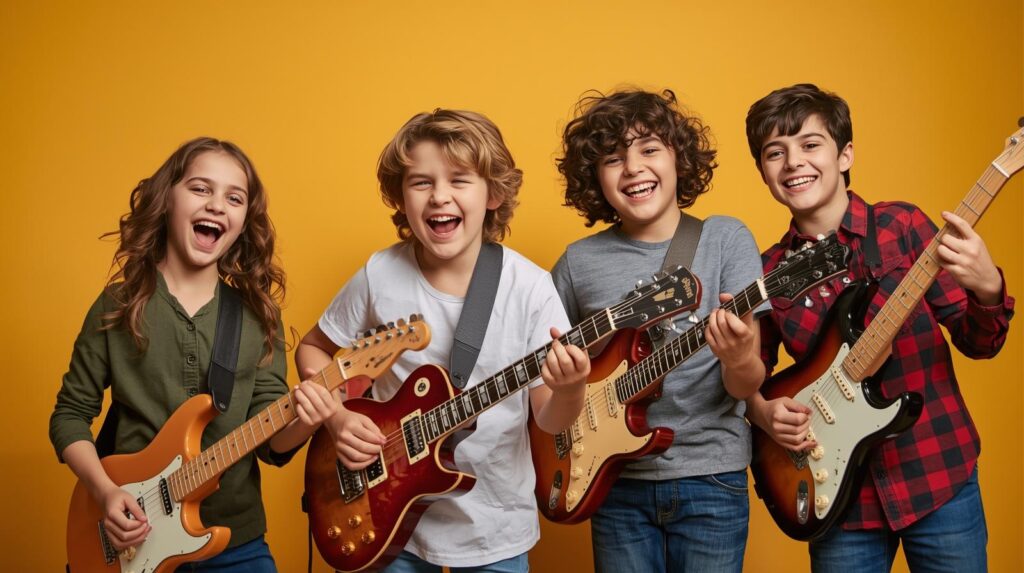
I’ve heard about it hundreds of times over 30 years. And I can tell you exactly why it happens:
Kids quit when learning feels isolating, frustrating, and pointless.
Private lessons create isolation – just you and the teacher, no peers to share the experience with.
YouTube creates frustration – working above your level with no one to diagnose what’s blocking you.
Both create a sense of pointlessness – “I’m doing this…why? For what? To play alone in my room?”
Group classes flip all of this. And that’s why kids in my group environment stick with guitar while kids everywhere else quit.
Let me show you what I mean.
The Socially Awkward Kid Who
Found His People
Zach came to me homeschooled and very shy. Socially awkward in that way some homeschooled kids are when they haven’t had much peer interaction.
I wasn’t sure how he’d handle the group environment at first.
But here’s what happened: He participated. Not right away, but gradually. The group setting gave him a safe space to interact with peers through music – something structured, something he could succeed at, something that didn’t require the social skills he was still developing.
Over time, he played with confidence. Not just technically confident – socially confident. Comfortable being part of the group, contributing his part, existing alongside other kids without the awkwardness that defined him when he started.
He never joined his church band like his mom wanted. But you know what he did do? Started performing at local theater. And acting in plays.
The kid who came to me struggling to make eye contact ended up on stage. In front of audiences. Acting and playing music.
That doesn’t happen learning from YouTube alone in your bedroom. That happens when you’re part of a group that gives you safe, repeated opportunities to build social confidence through music.
The Science Nerd Who Became the Cool Kid
Noah was the awkward science kid. Smart. Into things most 13-year-olds don’t care about. Exactly the type who gets labeled “nerd” and struggles socially.
In my group class, something shifted.
He wasn’t the awkward kid anymore. He was fun. He learned to play really well. And in that room, with those peers, working on music together?
Noah became the cool kid.
Not because he changed who he was fundamentally. Because the group environment valued what he brought – his focus, his intelligence applied to learning music, his quirky personality that actually fit once he had a context where it worked.
Other kids in the class genuinely liked him. Looked forward to playing with him. That social acceptance – earned through contributing to the group – gave him confidence that extended everywhere else.
Why Private Lessons Create Quitters
Here’s what typically happens in private lessons:
30 minutes goes by fast. By the time the student unpacks, tunes, reviews last week, gets feedback on mistakes, and packs up – they’ve barely played. Minimal reps. Minimal actual hands-on time.
There’s no one to share it with. Learning happens in isolation. No peers working on the same challenge. No one to compare notes with. No social energy.
Mistakes feel like failure. When it’s just you and the teacher, every mistake gets highlighted. There’s no “everyone’s learning this together” safety net.
It’s easy to manipulate or coast. The kid who’s mom brought him to me because he figured out how to pout his way out of challenging material. Private lessons make this possible.
Josh came to me hyperactive and a class clown. In a private lesson, he would have derailed every session – constant interruptions, jokes, inability to focus.
In the group? He learned to dial it back.
Not because I forced him. Because being part of a team means you can’t dominate the space. You have to contribute appropriately. You have to let others have their moments too.
Within a few months, Josh regulated his own behavior. The group taught him what private lessons never could: how to be part of something bigger than himself.
The Peer Accountability That Feels Natural
Here’s the beauty of group classes: Kids push themselves without being pushed.
When everyone’s working on the same concept – even if each student is at a slightly different level – nobody wants to be the one who didn’t practice.
Not because they’re afraid of punishment. Because they don’t want to let the group down. Because they want to contribute when it’s time to play together.
Crystal was a really good player. Started around 13. Went to the same church as several of my other students who played on worship teams.
She easily could have joined them. Had the skills. Had the opportunity.
Never did.
And that’s fine. Because the value she got from guitar wasn’t about performing at church. It was about being part of a musical community during her teen years. About developing skills she enjoyed. About belonging to something.
She stuck with guitar not because she had performance goals, but because the group made it worthwhile week after week.
That’s what keeps kids engaged long-term. Not external achievements – internal satisfaction from being part of something.
The Long-Term Progression
Nobody Talks About
Leo started with me at 10. Stayed for many years. Never played out publicly. Just played with his friends for fun.
They got good. Really good. But performing wasn’t the goal.
The group environment gave him a musical community. His friends were in the class. They learned together. They played together outside of class. Guitar became the thing they did together – not a solo activity, but a shared experience.
That’s why he stuck with it for years. Not because he was chasing a dream of being a musician. Because it was fun, social, and meaningful.
Oliver has been with me for two years – systematic progression, just like Nathan. He’s developing skills methodically, building competency layer by layer.
Will he play at church like his mom wants? Maybe. Will he join a band? Possibly. Does it matter?
Not really. What matters is he’s engaged, progressing, and not quitting like 90% of kids who start guitar.
From Kids Class to Teen Class to Adult Class
Here’s something most parents don’t know: I transfer students to adult classes somewhere between 14 and 16. Depends on maturity.
Alex started with me at 13. Shy. Quiet. Stayed until he went to college.
Over those years, he gained massive confidence. Not just in guitar – in interacting with adults. Being part of adult conversations. Holding his own in a room with people 20, 30, 40 years older.
When I moved him to the adult class, he didn’t just survive – he thrived. Because the group environment had been building those social skills all along.
That progression – kids / early teen class → adult class – shows something important: My students don’t quit. They graduate.
They don’t age out of guitar because their bodies can’t handle it anymore like sports. They progress into more advanced environments because they’ve built skills and social confidence that let them keep growing.
What Group Actually Provides
Let me be specific about what keeps kids coming back to group classes week after week:
Constant hands-on time. Not waiting for “your turn” – everyone plays, everyone practices, everyone gets reps while the teacher circulates.
Shared experience. Learning the same concepts alongside peers. Struggling together. Succeeding together. It’s inherently more engaging than solo practice.
Safe mistakes. When everyone’s learning, mistakes aren’t embarrassing – they’re normal. Kids see others fumble and recover. They learn to troubleshoot without a teacher hovering.
Social connection. Real friendships built around music. Face-to-face interaction, not screens. Belonging to something.
Natural accountability. Peer pressure that feels encouraging, not punishing. Kids practice because they don’t want to let the group down.
Playing together immediately. Not “someday you’ll be good enough to play with others” – from day one, kids hear their part fitting into the larger sound. That’s addictive.
The Mini-Band Effect
Even beginners can strum simple chords while another student picks out a melody. Before long, you’ve got a mini-band forming in the classroom.
That moment when kids hear their individual parts fit together into something bigger? That’s when guitar clicks from “activity I do” to “thing I love.”
And here’s the skill they’re developing without realizing it: how to layer parts. How to fit what they’re playing into the bigger picture. How to listen, adjust, and contribute.
This is what every musician needs if they want others to enjoy playing with them.
Piano students often struggle with this. They’re used to reading notes off a page, playing complete arrangements solo. They don’t learn to create supportive parts that blend with what’s happening around them.
Guitar students in my group classes get this skill built in from day one.
And it’s why they stick with it. Because music stops being something you do alone and becomes something you do with people.
What Parents Actually See
Parents tell me things like:
“My child is more excited for guitar than any other activity.”
“They’re actually practicing without me nagging.”
“I can see them becoming more confident – not just in music, but in general.”
“The friendships they’ve made in class are real. They talk about their classmates all week.”
Zach went from socially awkward to performing in the theater.
Noah went from awkward science nerd to the kid everyone wanted to play with.
Josh went from hyperactive class clown to self-regulated team member.
Alex went from shy 13-year-old to college student who can hold his own with adults.
These transformations don’t happen in private lessons. They don’t happen learning from YouTube or apps.
They happen when kids are part of a group that gives them repeated opportunities to build musical and social skills simultaneously.
The Real Question
The question isn’t “will my child learn guitar?”
The question is: “Will my child stick with it long enough to actually benefit?”
Because the real value isn’t in learning a few chords. It’s in building confidence, social skills, self-regulation, and belonging over years – not weeks.
That’s what group classes provide. That’s why my students don’t quit.
Leo stayed for years playing with friends. Oliver’s been systematically building skills for two years. Alex stayed until college. Crystal kept coming even though she never performed.
They stuck with it because the group made it worthwhile. Social. Meaningful. Fun.
They’re in the window where group classes can give them not just guitar skills, but a musical community that keeps them engaged for years.
Not “let’s see if they stick with it” – an environment specifically designed to make sticking with it the natural outcome.
Where social connection reinforces musical progress. Where peer accountability feels encouraging, not punishing. Where kids graduate from beginner to intermediate to advanced – and eventually into adult classes if they want.
That’s what 30 years of teaching has taught me: Kids don’t quit when learning is social, engaging, and meaningful.
They quit when it’s isolated, frustrating, and pointless.
Group classes eliminate all three problems.
About The Author
Brian Fish is a professional guitarist who has been dedicated to helping other guitar players in Northeast Ohio pursue their musical dreams since 1994. He’s passionate about guiding others on their musical journey! He is the Guitar Playing Transformation Specialist, instructor, mentor, trainer, and coach at
Guitar Lessons Geauga.
Brian has also assisted people from around the globe in developing a solid sense of timing and enhancing their creativity through the fantastic rhythm course, “Ultimate Rhythm Mastery,” available at MusicTheoryForGuitar.com.
If you live in Geauga County / North East Ohio, Guitar Lessons Geauga can help you become the player you’ve always wanted to be.