
I get students all the time who have been “teaching themselves” from YouTube or apps for months.
In a 45-minute free intro lesson, I’m able to get most of them playing more than they learned in all that time on their own.
Not because I’m doing anything magical.
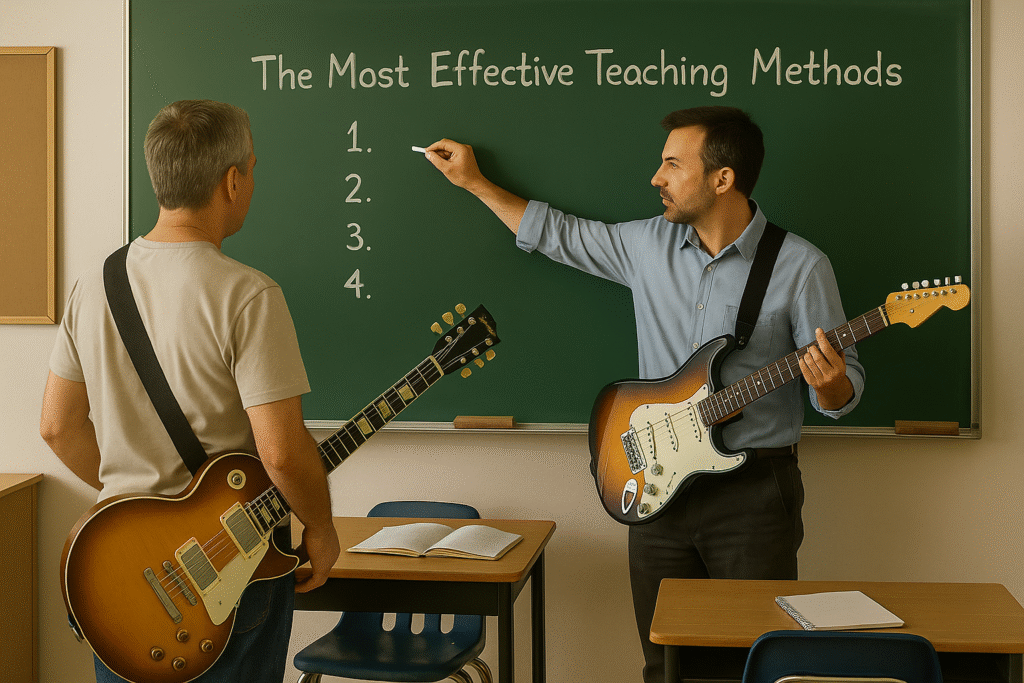
Because I can diagnose what’s blocking them – and fix it immediately.
The person who’s been taking lessons for a year but “knows bits and pieces of random songs and nothing comes together”? I can see in five minutes why: their previous teacher let them bounce randomly between material instead of building systematically.
The individual whose private teacher starts every lesson with “what do you want to work on today?”? I know exactly what happened: they’ve been working too hard some weeks, too easy others, never at the right level for actual progress.
Most guitar teachers are winging it. They’re talented players who decided to start teaching, but they don’t actually know how to diagnose what’s blocking a student or how to build skills systematically.
After 30 years of teaching in North East Ohio, most of the time in Newbury, and ongoing training with elite instructors from around the world, I can tell you: the difference between trained instruction and winging it is the difference between someone thriving or quitting.
The Difference Between Playing and Teaching
Most guitar teachers are simply players who decided to start teaching.
They might be talented musicians. They might play in bands. They might be technically impressive.
But talent doesn’t make you a teacher.
Think about it: Would you hire a math tutor just because they’re good at math? Or would you want someone who actually understands how people learn, what keeps them motivated, and how to diagnose when a student is stuck?
Here’s what untrained teachers typically do:
They teach the way they learned – which was probably random, inefficient, and full of dead ends. Just because you eventually figured it out doesn’t mean you know how to teach it systematically.
They let students dictate the lessons – “What do you want to work on today?” sounds like good customer service. It’s actually abandoning your responsibility as a teacher. The student doesn’t know what they need. That’s why they’re paying you.
They use method books as a crutch – Not because the book is the right approach for this specific student, but because it’s easy. No thought required. Just flip to the next page.
They can’t diagnose what’s actually wrong – They see a student struggling and say “practice more.” A trained teacher sees a student struggling and identifies the specific block: wrong level of difficulty, wrong approach for this personality type, wrong expectation management, wrong emotional framework.
What Actually Happens With Untrained Teachers
People come to me all the time after they tried lessons elsewhere.
The story is always the same:
They learned a few chords but didn’t understand how anything connected. They felt stuck. Practice became a struggle. Eventually, they wanted to quit.
Sometimes it’s the crying kid who manipulated his private teacher for a year — learning he could pout his way out of challenging material. His mom finally realized: “He’s not actually learning. He’s just getting his way.”
Sometimes it’s the adult who came in frustrated and ready to quit because her last teacher insisted she learn basic folk strumming and melodies before anything else — even though she wanted to play hard rock. Some of the hard rock material she wanted to learn was actually easier than what she was being forced through. My guess is that teacher just didn’t know any hard rock.
Sometimes it’s the person who’s been taking lessons for a year but “knows bits and pieces of random songs and nothing comes together.”
Sometimes it’s the individual whose teacher starts every lesson with “what do you want to work on today?” — so they bounce randomly between too-hard material one week and too-easy material the next, never building any systematic foundation.
It’s not that these teachers are bad people. Most of them care deeply about their students.
But they’re winging it. They don’t have a systematic approach. They don’t know how to diagnose what’s blocking progress. They don’t know how to manage the emotional and psychological aspects of learning that determine whether a student thrives or quits.
What Training Actually Looks Like
For over 12 years, I’ve been part of a global network of elite guitar teachers – about 100 of us from around the world.
We meet regularly online. We train together in person in Chicago – teachers from multiple countries gathering to refine our approach.
But here’s what makes this different from typical music education:
We don’t just share teaching tips. We systematically test what works.
One of our members has a PhD in science. He runs actual A/B tests on different teaching approaches. Not opinions. Not anecdotes. Real data on what produces better results.
For example: fastest way to learn all the notes on the fretboard. Most teachers have an opinion. We have test results showing which method actually works better.
That’s the difference between trained instruction and winging it.
Many members run highly successful music schools in major markets. They’ve figured out what works at scale – not just with one or two students, but with hundreds. And we share that knowledge systematically.
How This Shows Up in My Teaching
When a student comes to me after months on YouTube with almost zero progress, I don’t just give them easier songs.
I diagnose that they’re working above their actual level. I use my layering approach — stripping songs down to their core, letting them play simplified versions that sound good with backing tracks, then building complexity back in systematically.
That methodology didn’t come from randomly teaching for 30 years. It came from training with elite teachers who’ve tested what actually works.
When Bryan from Chardon came to me wanting to play on his worship team, I mapped out exactly what skills he needed: chord knowledge, lead sheet reading, rhythm, capo usage, and guitar part creation. That’s what I do with every student — identify the goal and build the shortest path to get there. No wasted time on things that don’t serve that goal.
When the crying kid came to me from private lessons, I didn’t just tell him to “try harder.”
I put him in an environment where manipulation doesn’t work. Where you’re part of a team. Where accountability comes from peers, not just the teacher.
Within a month, he was a different student. Not because I was tougher — because I knew how to structure the learning environment to manage his behavior.
Not because I’m magical — because I’ve been trained in systematic skill development that produces specific outcomes.
Evidence-Based vs. Opinion-Based Teaching
Here’s what most people don’t realize:
Most guitar instruction is opinion-based.
“I think you should learn this song next.” “I feel like you’re ready for barre chords.” “In my experience, this approach works.”
Trained instruction is evidence-based.
We know which methods produce faster results because they’ve been tested. We know which approaches keep students engaged long-term because we’ve tracked hundreds of students over years. We know how to diagnose specific blocks because we’ve been trained to see patterns.
When I look at a student and say “here’s what’s holding you back,” I’m not guessing. I’m applying systematic diagnostic frameworks developed by elite teachers over decades.
When I say my layering approach builds competency faster than traditional methods, that’s not marketing – it’s based on tested results across hundreds of students.
Why This Matters
You don’t just need someone who can play guitar.
You need someone who can:
- Diagnose what’s actually blocking your progress (not just your technique, but your expectations, emotions, and learning style)
- Adapt instruction to your specific personality and needs
- Build skills systematically using methods that have been proven to work
- Manage the psychological aspects that determine whether you stick with it or quit
- Create the right learning environment (accountability structures, social dynamics, etc.)
That’s the difference between trained instruction and someone winging it. That’s why students who spent months getting nowhere make dramatic progress in their first few weeks with me.
That’s why Patrick from Chagrin Falls — who had spent a ton of time with online courses — still couldn’t strum in time. Once I showed him the proper mechanics and how to practice them correctly, his playing improved immediately. Within a few months, those habits were locked in.
That’s why Elliot went from knowing one song to making plans to move to Nashville for session work in just four years — because he learned deliberate practice from a trained teacher, not aimless noodling.
That’s why Matt from Chardon — who had taken online lessons from one of the biggest names in the guitar community — still came in with major gaps in his fretboard knowledge. Once I showed him what to practice and how, he picked it up fast. Really fast. And once those holes were filled, his playing immediately improved across the board.
That’s why Derek, who struggled from age 7 to 12, suddenly blossomed once his development caught up — he never lost his love for guitar despite the frustration, and I knew to wait for the window instead of giving up on him like most teachers would have.
Not because these students are exceptionally talented. Because they received trained instruction designed to produce these outcomes.
How to Tell If a Teacher Is Trained
Most teachers won’t tell you about their training because they don’t have any. They’ll talk about their playing experience, their gigs, and their favorite artists.
That’s not teaching credentials. That’s playing credentials.
Here’s what to ask:
“What systematic approach do you use for skill development?” If they can’t articulate a clear methodology, they’re winging it.
“How do you diagnose when a student is stuck?” If they say “more practice” or “some students just take longer,” they don’t actually know how to diagnose blocks.
“How do you adapt your instruction to different personality types?” If they look confused by the question, they don’t understand that teaching is about managing people, not just delivering content.
“What ongoing training do you participate in?” If they’re not actively training with other elite teachers, they’re relying on old knowledge in a field that’s constantly evolving.
The Investment That Actually Pays Off
You could go with a teacher who’s winging it. You might learn a few things. You might even enjoy it for a while.
But you’re unlikely to reach the outcomes my students reach. Adults who spent years stuck finally playing with real confidence. Kids playing at church by their mid-teens. Students who came in frustrated and are now contributing to bands, writing their own music, and building skills that last a lifetime.
Those outcomes don’t happen because someone showed you a few chords and wished you luck.
They happen because of systematic, trained instruction designed to produce specific results.
That’s what 30 years of experience plus ongoing elite training delivers.
That’s what separates Guitar Lessons Geauga from the teacher down the street who’s just winging it.

About The Author
Brian Fish is a professional guitarist who has been dedicated to helping other guitar players in Northeast Ohio pursue their musical dreams since 1994. He’s passionate about guiding others on their musical journey! He is the Guitar Playing Transformation Specialist, instructor, mentor, trainer, and coach at
Guitar Lessons Geauga.
Brian has also assisted people from around the globe in developing a solid sense of timing and enhancing their creativity through the fantastic rhythm course, “Ultimate Rhythm Mastery,” available at MusicTheoryForGuitar.com.
If you live in Geauga County / North East Ohio, Guitar Lessons Geauga can help you become the player you’ve always wanted to be.