
(Hint: It's Not About Playing Faster or Knowing More Songs)
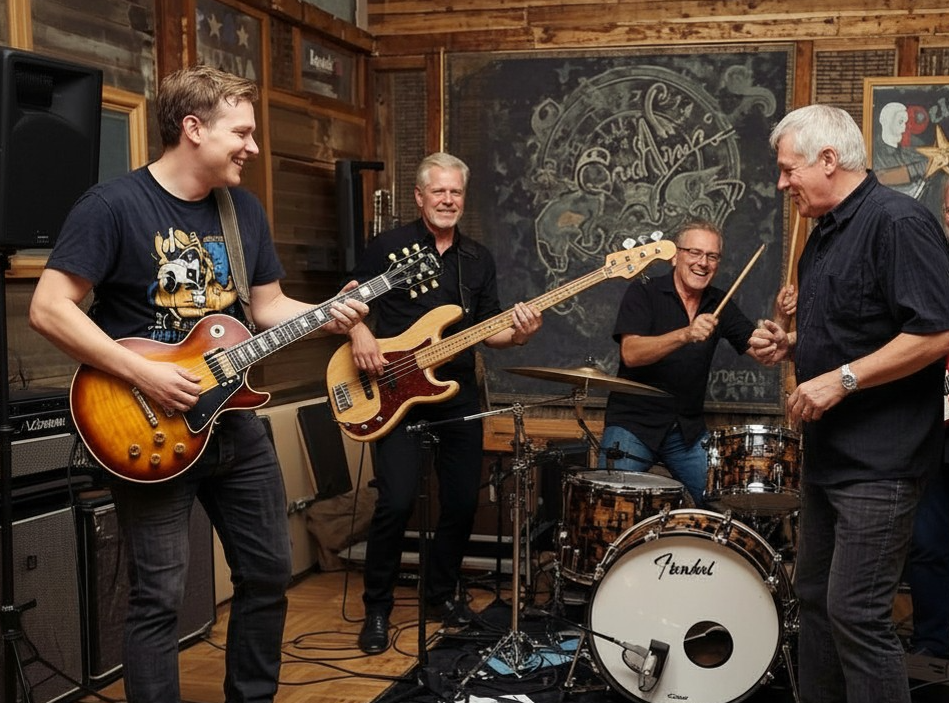
Picture this: You’re at a jam session or rehearsal. The drummer locks eyes with you and grins because the pocket is so tight. The singer relaxes into the song because your foundation is unshakeable. When someone’s organizing a band or planning a gig, your name comes up first.
That’s not fantasy. That’s what happens when you become the guitarist others can lean into, lock onto, and trust.
But here’s what most players don’t realize: the skill that makes you indispensable isn’t flashy solos or knowing a thousand songs. It’s your ability to listen, adapt, and make decisions in real time — while you’re playing. And honestly? How well you get along with people. Are you easy to work with? Because that matters as much as how well you play.
Being great in a band setting isn’t just about having solid individual skills. It’s about how you use those skills with other people.
Know What the Situation Requires
Playing with others isn’t about having a fixed part you play no matter what — unless the music demands it.
Here’s the distinction: In riff-based rock, metal, punk, or any genre built on signature guitar parts, your job is to nail those parts with precision and consistency. Think “Smoke on the Water,” “Iron Man,” or “Enter Sandman.” These aren’t suggestions — they’re the song. The player everyone wants in these situations is the one who can lock into those parts perfectly, every single time.
But in singer-songwriter settings, jazz, blues, country, worship music, or open-ended jam situations, you need flexibility. Sometimes the best thing you can do isn’t to fill space — it’s to leave space. Whole-note chords can let the music breathe. Sparse rhythms create drama and tension. A simple, clean texture often hits harder than a wall of busy strumming.
The key skill? Knowing which situation you’re in — and responding accordingly.
In a cover band playing “Back in Black”? Play Malcolm Young’s part exactly as written. That IS your value.
In a worship band where the arrangement changes every time? You need to adjust on the fly — reading the room, the dynamics, the other instruments.
A player who gets invited back is constantly asking:
- Is this a situation where I need to nail a specific part, or do I have creative freedom?
- Should I play a lot or little?
- Do I need to push the energy or sit back?
- What register should I play in so I’m not clashing with bass or keys?
- Should I strum, pick, arpeggiate, or lay out completely?
What sounds great at a solo coffee shop gig is often overwhelming and muddy when played with a band. The players everyone wants? They listen, they know their role, and they respond to what’s happening around them.
Interact With the Band, Don't Fight It
So what does that actually look like in practice? It depends on who’s on stage with you.
When there’s a keyboard player: Stay out of the mid-range where piano naturally sits. Focus on either low, chunky rhythms or higher, shimmering voicings. If the keys are playing sustained chords, you might play more rhythmic, percussive patterns.
When the bass is busy: If the bassist is playing melodic lines or complex patterns, simplify your playing. Let them have their moment while you provide the harmonic foundation.
In a three-piece band: You often need to be bigger — covering more frequency range, filling more space. But that doesn’t mean louder; it means smarter voicing choices.
If you sound great alone but cluttered in a band mix, the answer is almost always the same: play less and listen more.
Communication Happens On Stage, Not Just in Rehearsal
This is the part most players never think about until they’re in the middle of it and realize they’re lost.
In a worship band I played in, the song structure was flexible. A bridge or chorus could be repeated at any point — you never knew until it happened. You had to make eye contact with the worship leader to know what was coming. We had hand signals for repeat, for ending, for bringing the music down because someone was going to talk or pray. If you weren’t watching, you were going to miss it. And being the only one playing the wrong thing in front of a congregation is no fun.
At a jam session, it’s a different challenge — you just met these people. You’ve never played together before. Nobody has discussed how the song ends. But there are some universal signals that most experienced players recognize. An arm moving down with the palm toward the floor usually means bring the music down. A head nod pointed your way often means it’s your turn to solo. A nod or a point toward someone else means wrap it up and let them play. A raised guitar headstock brought down sharply is one way to signal a tight ending — put a stinger on it and everybody stops together.
If you don’t know these signals, you’re the person who keeps soloing after everyone else moved on, or who keeps playing after the song ended. You learn to read these signals, or you don’t get invited back.
A band I was in for years operated at another level entirely. We didn’t have a set list. We’d read the crowd and either the singer or I would pick the next song on the fly — and we needed the rest of the band to know before the current song ended, because we wanted minimum downtime between songs. Ideally no gap at all. The singer would have us bring the music down so he could talk to the crowd, which meant the band had to vamp on a section and know exactly when to come back in at full volume — or when to build gradually. The audience heard seamless music. They had no idea there was a whole conversation happening on stage.
That level of communication doesn’t happen by accident. It’s a skill you develop, and it’s one of the biggest reasons certain players get the call and others don’t.
Do You Panic, or Do You Adjust?
Things go wrong at every gig. Someone comes in in the wrong key. Someone skips a verse. The sound cuts out for two bars. A string breaks mid-song.
The players everyone wants to play with are the ones who don’t panic. They adjust. They cover. They keep the music moving while the problem gets sorted out, and half the time the audience never knows anything went wrong.
The players who don’t get invited back are the ones who freeze, or stop playing, or make a face that tells the whole room something just fell apart.
This comes down to how comfortable you are making real-time decisions under pressure. Can you simplify what you’re playing on the fly to cover for someone else? Can you vamp on a section you weren’t expecting to vamp on? Can you follow a bandmate who went somewhere you didn’t expect, instead of stubbornly playing what you rehearsed?
The ability to adjust — calmly, in the moment, without derailing the song — is worth more than any technical skill you can put on a resume.
The Real Secret
The guitarists who get invited to every session and every gig aren’t necessarily the ones who can play the fastest or know the most songs. They’re the ones who’ve learned to:
✓ Read the situation — Know whether to nail a specific part or create something in the moment
✓ Listen constantly— Adjust to what every other instrument is doing
✓ Communicate on stage — Through eye contact, body language, and signals
✓ Stay calm under pressure — Adjust when things go sideways without the audience ever knowing
✓ Serve the song — Play what the music needs, not what feeds your ego
✓ Be easy to work with — Because nobody calls back the difficult person, no matter how good they are
Be the player the band needs — the one they can lean into, lock onto, and trust. Be the guitarist who makes the drummer smile because the pocket is so deep. Be the player who makes the singer confident because the foundation is unshakeable.
When someone’s putting together a band, planning a recording session, or organizing a jam night — they think of you first. Not because you play the most notes, but because you make everyone sound better.
That’s the guitarist everyone wants to play with.

About The Author
Brian Fish is a professional guitarist who has been dedicated to helping other guitar players in Northeast Ohio pursue their musical dreams since 1994. He’s passionate about guiding others on their musical journey! He is the Guitar Playing Transformation Specialist, instructor, mentor, trainer, and coach at
Guitar Lessons Geauga.
Brian has also assisted people from around the globe in developing a solid sense of timing and enhancing their creativity through the fantastic rhythm course, “Ultimate Rhythm Mastery,” available at MusicTheoryForGuitar.com.
If you live in Geauga County / North East Ohio, Guitar Lessons Geauga can help you become the player you’ve always wanted to be.