
(And Why It’s the Key to Playing Things You Think Are Impossible)
I’m going to tell you about the single most resisted change I make with new students.
Not a chord. Not a scale. Not some advanced technique.
How they hold the guitar.
I’ve been teaching for over 30 years. In that time, I’ve had hundreds of students sit down across from me, guitar balanced on their right thigh, body slouched forward, neck angled down toward the floor. They look comfortable. They feel comfortable.
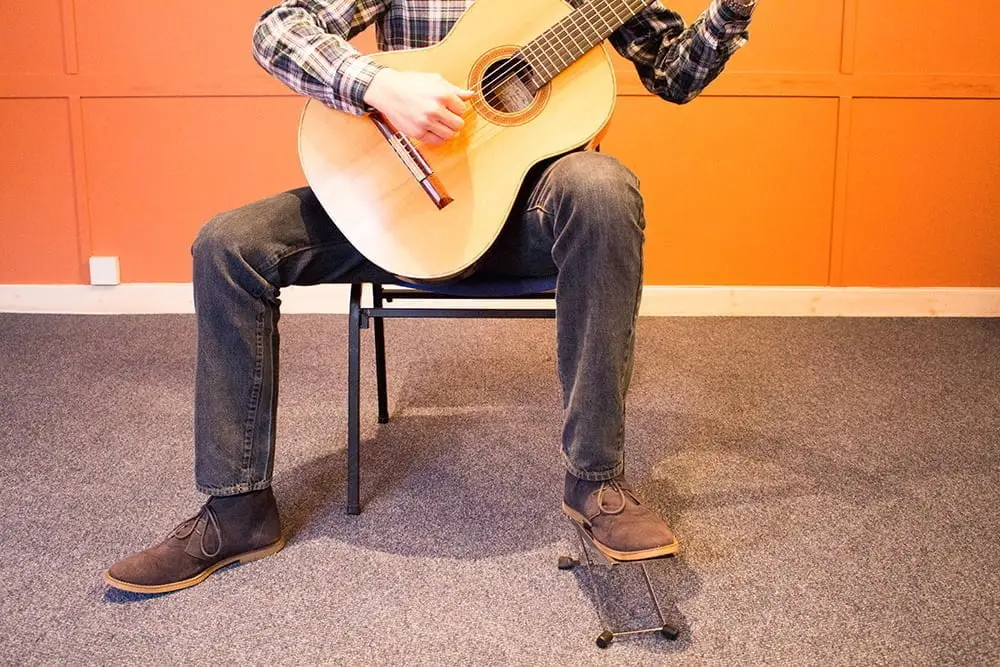
And then I ask them to change everything about how they’re sitting.
The reaction is almost always the same. They try it. Their face scrunches up. And they say some version of: “This feels really weird.”
I know. It does feel weird. At first.
What I also know — because I’ve watched this scene play out hundreds of times — is that the students who push through that awkward phase and buy into the change? Things they thought were physically impossible on guitar suddenly become playable.
Every. Single. Time.
What's Wrong With How You're Sitting Right Now
Here’s what most people do: they sit back in a chair, rest the guitar on their right thigh (if they’re right-handed), and let the neck drift downward. It feels natural because it’s relaxed. No effort required.
But “relaxed” and “efficient” aren’t the same thing. That position creates real problems that get worse the longer you play:
Your fretting hand has to twist into awkward angles just to reach the fretboard. Your wrist bends in ways it wasn’t designed to bend. Your shoulder hunches forward. Your back rounds. And the guitar neck points at the floor, which means you’re craning your own neck down just to see what your fingers are doing.
Play like that for twenty minutes and you probably won’t notice. Play like that for a year and you’ll start wondering why your wrist hurts, why barre chords feel impossible, and why certain chord changes seem like they require fingers you don’t have.
It’s not your fingers. It’s your position.
But here’s the real kicker: when you practice in that slouched position and then stand up to play — with a strap on, at a jam or on a stage — the guitar is in a completely different place. Your hands are at different angles. Your muscle memory doesn’t transfer. You’ve been practicing one way and performing another, and your brain has to recalibrate every time you switch.
That’s not a minor inconvenience. That’s sabotaging your own progress.

The Position That Fixes It (And Why Students Fight It)
What I teach every student is to sit near the front edge of their chair, place the guitar on the left thigh, and elevate that thigh with a footstool or guitar support. The neck angles upward. The spine stays straight. The guitar sits closer to the body.
This is often called “classical position,” and that name is part of the problem. People hear “classical” and think: that’s not for me, I play rock. Or blues. Or country. Or whatever.
But this position wasn’t invented for classical music. It evolved over centuries because players kept experimenting until they found the most efficient, most ergonomic, most technically sound way to hold this instrument. It’s not about genre. It’s about physics and anatomy.
Your body doesn’t know what genre you play. It just knows whether it’s in a mechanically efficient position or a mechanically compromised one.
So why do students fight it?
Because it feels uncomfortable at first. And I get it. You’ve spent months or years training your body to hold the guitar one way. When I move it to the other thigh and angle the neck up, everything feels foreign. Your brain is screaming “this is wrong” even though your body is actually in a much better position.
Some students push back for a few lessons. Some push back for a few weeks. I’ve had students argue with me about this for months before they finally commit. But I’ve never — not once in 30 years — had a student commit to this change and come back saying it made things worse.
Not once.
What Changes When You Get This Right
When the guitar is positioned properly, something almost magical happens with your fretting hand.
Instead of wrapping your hand around the back of the neck like you’re gripping a baseball bat, your hand approaches from below. Your wrist straightens out. Your fingers naturally spread across the fretboard at a better angle. You get more reach with less effort.
That barre chord you’ve been fighting with for six months? Suddenly your index finger can lay flat across the strings without your wrist screaming at you. That stretch between the second and fifth fret that felt impossible? Your fingers can actually get there because they’re approaching from the right angle.
I’ve lost count of how many times a student has been struggling with something for weeks, I adjust their position, and they play it cleanly on the next attempt. The look on their face is always the same: part relief, part disbelief, part annoyance that it was “that simple.”
You still have to develop the habit. But proper position removes the unnecessary obstacles that were making everything harder than it needed to be.
Your Strap Isn't Just for Standing
Here’s something most players never think about: your strap is one of the most important tools you have for consistent practice, even when you’re sitting down.
Think about it. When you stand up to play, the guitar hangs from a strap. It sits in a specific place on your body. When you sit down, most people take the strap off and the guitar drops to a completely different position. Two different setups, two different sets of muscle memory.
Instead, keep your strap on while you’re seated. Adjust it so it holds the guitar in the same position whether you’re sitting or standing. When you do this, everything stays consistent. Your hand positions don’t change. Your visual reference points don’t change. What you practiced in your chair transfers directly to when you stand up.
This means the strap needs to be shorter than most rock guitarists think it should be. I know, I know. The guitar hanging at your knees looks cool. But there’s a reason every technically proficient player in every genre wears their guitar higher than that. It’s where the instrument actually works best with your body.
And here’s the thing nobody notices: even the players who sling their guitar low end up cheating their way back to proper position when it’s time to actually play something difficult. They put a foot up on the monitor. They drop to one knee. They rest the guitar on their thigh. All iconic rock moves — and every single one of them brings the guitar right back to that elevated, classical-style position. They figured out the same thing centuries of classical players did. They just made it look cooler doing it.
You can look cool, or you can play well. In my experience, playing well ends up looking a lot cooler than a guitar dangling at your knees while you struggle with an F chord or a blues boogie pattern that requires a pinky stretch..
This Isn't About Being a Classical Guitarist
I want to be clear about something: adopting proper position doesn’t mean you need to play classical music, buy a nylon string guitar, or start wearing a tuxedo to your jam sessions.
It means you’re using the position that gives your body the best mechanical advantage for playing this instrument. The same laws of physics and ergonomics apply whether you’re playing Bach or Black Sabbath.
A lot of professional players across every genre have figured this out. They may not use a footstool on stage, but watch how they hold the guitar. The neck is elevated. The body is close. They’re not slouched over with the instrument pointing at the floor. They’ve found positions that let them play efficiently because their careers depend on it.
You don’t have to adopt every element of “classical technique.” But if you take the core positioning principles — guitar on the left thigh, neck angled upward, spine straight, strap on even when seated — you’ll remove a huge number of unnecessary obstacles from your playing.
The Long Game: Your Body Will Thank You
Beyond the immediate technical benefits, there’s a long-term reason this matters: your body has to last.
I’ve seen players in their 40s and 50s develop wrist problems, shoulder issues, and chronic back pain from decades of poor positioning. Some of them have had to stop playing for a long time, if not entirely. All of that was preventable.
Proper position keeps your wrist aligned, your spine straight, your shoulders relaxed, and your arms in natural positions. It’s the difference between an athlete who trains with proper form and one who compensates with bad mechanics until something breaks.
You want to be playing guitar in twenty years? Thirty years? Then how you sit matters just as much as what you play.
Yes, It Feels Weird at First. Do It Anyway.
If you’ve been playing in a slouched position for a while, switching to proper position is going to feel uncomfortable. That’s normal. Your body has adapted to the old way, and it needs time to adapt to the new way.
Give it a few weeks. Start with shorter practice sessions in the new position and gradually increase. Use a mirror to check yourself — you’ll think you’re sitting straight when you’re not. You’ll think the neck is elevated when it’s barely moved.
This is one of the hardest things to self-correct because you can’t see your own posture while you play. You think you’ve made the change, but you’ve actually drifted right back to where you started. It’s why having someone watching and giving real-time corrections makes such a huge difference.
The discomfort fades over time. For every student. What replaces it is a position where your hands can actually do what you’re asking them to do, where your body isn’t fighting you, and where what you practice transfers seamlessly from your chair to a stage.
I’ve had this conversation hundreds of times. I’ll probably have it hundreds more. And every time, the students who trust the process and commit to the change end up saying the same thing:
“Why didn’t someone tell me this sooner?”

About The Author
Brian Fish is a professional guitarist who has been dedicated to helping other guitar players in Northeast Ohio pursue their musical dreams since 1994. He’s passionate about guiding others on their musical journey! He is the Guitar Playing Transformation Specialist, instructor, mentor, trainer, and coach at Guitar Lessons Geauga.
Brian has also assisted people from around the globe in developing a solid sense of timing and enhancing their creativity through the fantastic rhythm course, “Ultimate Rhythm Mastery,” available at MusicTheoryForGuitar.com.
If you live in Geauga County / North East Ohio, Guitar Lessons Geauga can help you become the player you’ve always wanted to be.