
I can usually spot them within the first five minutes of an intro lesson.
They sit down, and before they even pick up the guitar, they start talking. They tell me about modes. They mention the pentatonic scale. They drop terms like “relative minor” or “circle of fifths.” They’ve clearly spent a lot of time studying.
Then I ask them to play something and they struggle.
They fumble through a chord change that should take two seconds. Their timing is way off. Their hands don’t move with any confidence. The gap between what they can talk about and what they can actually do is enormous.
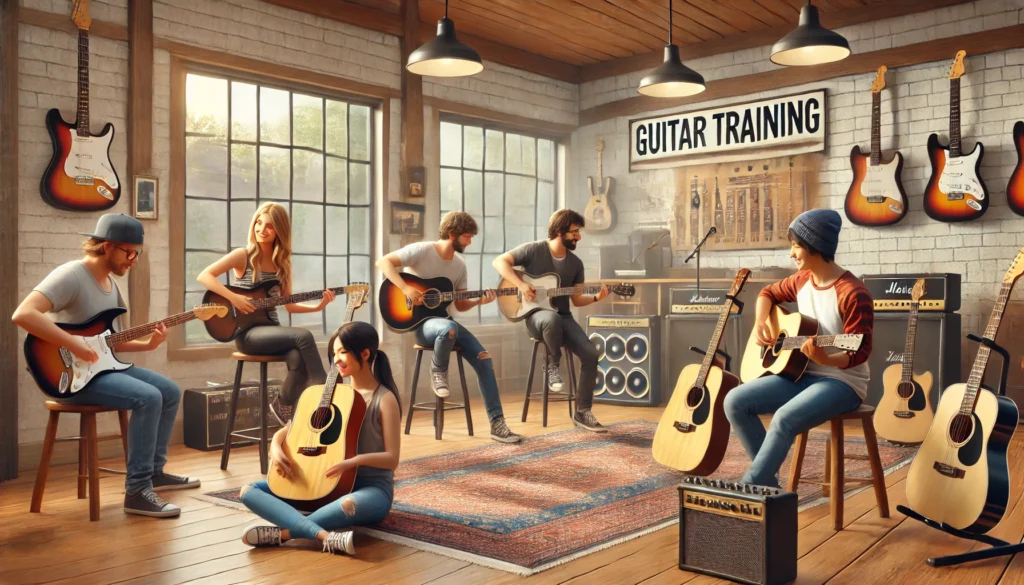
This isn’t rare. It’s one of the most common things I see after 30 years of teaching.
They didn’t fail to learn. They learned the wrong thing.
They learned about guitar instead of learning to play guitar. And those are two completely different things.
The YouTube Knowledge Trap
Here’s how it usually happens.
Someone gets excited about guitar. They start watching YouTube videos. They read articles. They join forums. They absorb hours and hours of information about music theory, scales, chord construction, gear, technique tips — and they don’t stick with one teacher. They watch whoever comes up next. One guy explains chords this way, the next guy explains them a different way, and a third guy has his own system entirely. Each video might be fine on its own, but none of it is building toward the same destination — and almost none of it is turning into actual playing ability.
It feels like progress because your brain is working. You’re learning new concepts. You can follow along when someone explains how the major scale works or why a dominant 7th chord resolves the way it does.
But understanding a concept and being able to use it on the fretboard are not the same thing. Not even close.
Knowing that the pentatonic scale has five notes doesn’t help you sound good when you improvise over a 12-bar blues. Knowing what a barre chord is doesn’t mean your hand can form one cleanly. Knowing the theory behind chord progressions doesn’t mean you can change between chords in time with a song.
Information sits in your head. Skill lives in your hands.
And the only way to move something from your head to your hands is structured, guided practice — not more videos.
The Frankenstein Problem
Here’s what makes this worse than just “not knowing enough.”
It’s not that they watched one teacher and got confused. It’s that they watched several teachers — each with a different approach — and stitched together pieces from all of them. A bit of one person’s method here, a chunk of another person’s explanation there, and none of it fits together because the approaches weren’t designed to be combined.
An experienced player can watch three different teachers explain the same concept three different ways and think, “I see what each of them is getting at — they’re all saying the same thing from different angles.” But a beginner doesn’t have that big-picture view yet. They take each explanation at face value, and when those explanations seem to contradict each other, they either get confused or — worse — they blend them into their own version that doesn’t actually work.
The CAGED system is the single best example of this.
It’s probably the most taught fretboard system on YouTube, and it’s also the most confusing system ever invented for learning guitar. Five shapes. Two of them are genuinely useful. One sort of makes sense if you already have enough experience to see where it fits. And two of them? You’ll never use them in real playing. Ever.
But because most YouTube teachers present CAGED as the way to learn the fretboard, students come in having watched five different explanations, each one slightly different, and they’ve ended up with a tangled mess in their head that they can’t apply to a single song. They spent weeks studying a system that a good teacher would never have started them on in the first place — because there are much better ways to learn the fretboard that actually translate into real playing.
That’s the hidden cost of learning from multiple sources without guidance. You don’t just miss things. You absorb contradictory information, build on a broken foundation, and never find out until someone actually watches you play and asks, “Who taught you to do it that way?”
The Guy Who Reads About the Gym
I use this analogy with students all the time.
Imagine a guy who reads every bodybuilding magazine, watches training videos constantly, can tell you the exact science behind muscle hypertrophy, periodization, and optimal protein intake. He could pass a written test on strength training better than most personal trainers.
But he never actually goes to the gym.
Or worse — he goes to the gym but only does one exercise, and he’s been doing it with terrible form for two years because nobody ever corrected him.
That’s what happens when you study guitar without training specific skills so you can apply them. You accumulate knowledge, but your hands — the things that actually produce music — haven’t been developed. And the small amount of playing you do is often reinforcing mistakes because no one is watching.
Knowing vs. Doing
There’s a reason athletes don’t learn their sport from textbooks.
A basketball player doesn’t become a great free-throw shooter by reading about arc trajectory and wrist mechanics. Those things might help him understand what he’s doing, but the skill itself comes from standing at the line and shooting — thousands of times — with a coach watching, correcting, and adjusting.
Guitar works exactly the same way.
Music theory is useful. Understanding why things work helps you make better musical decisions. But theory without execution is just trivia. It’s the difference between someone who can explain how an engine works and someone who can actually tear one apart and fix it.
The guitarist who can play three chords cleanly, in time, and transition between them smoothly is a better player than someone who can explain modal interchange but can’t get through a song without stopping.
Execution beats knowledge every single time.
Why a Teacher Changes Everything
When I sit down with someone at an intro lesson, I’m not just listening to what they play. I’m diagnosing how they play.
Are their fingers in the right position? Is their timing actually solid, or does it just feel solid to them because they’ve never played with anyone else? Are they practicing material at the right level, or are they working on something that’s three levels above where their hands actually are?
These are things no video can tell you. A video plays forward whether you’re doing it right or wrong. It doesn’t stop and say, “Your thumb is in the wrong spot, and that’s why this chord sounds dead.” It doesn’t notice that you’re rushing every time you hit the bridge of a song. It doesn’t know that you’ve been confusing two different concepts for six months.
A trained teacher catches all of this — usually in the first lesson. And instead of months of frustrated guessing, you get a clear answer and a specific fix.
That’s the difference between collecting information and actually building skill.
What Real Progress Looks Like
Real progress on guitar doesn’t come from learning more. It comes from training what you already know until your hands can do it without thinking.
That means focused repetition on specific skills — not jumping between random topics. It means playing with structure and accountability, not just noodling when you feel like it. It means having someone who can tell you what to work on next, because they can see what’s actually holding you back — not what you think is holding you back.
When my students make fast progress, it’s not because they’re more talented than the person watching YouTube every night. It’s because every minute of their practice is aimed at the right target, at the right difficulty level, with mistakes being corrected before they become habits.
That’s training. And it produces results that information alone never will.
Stop Collecting. Start Training.
If you’ve been spending more time learning about guitar than actually developing your ability to play, you’re not alone. It’s one of the most common traps out there, and the internet makes it incredibly easy to fall into.
The fix isn’t to learn more. It’s to practice smarter — with a plan, with feedback, and with someone who can see what you can’t see in your own playing.
Because at the end of the day, nobody in the audience cares about how many guitar videos you’ve watched or music theory books you’ve read.
They care about what comes out of your hands.

About The Author
Brian Fish is a professional guitarist who has been dedicated to helping other guitar players in Northeast Ohio pursue their musical dreams since 1994. He’s passionate about guiding others on their musical journey! He is the Guitar Playing Transformation Specialist, instructor, mentor, trainer, and coach at Guitar Lessons Geauga.
Brian has also assisted people from around the globe in developing a solid sense of timing and enhancing their creativity through the fantastic rhythm course, “Ultimate Rhythm Mastery,” available at MusicTheoryForGuitar.com.
If you live in Geauga County / North East Ohio, Guitar Lessons Geauga can help you become the player you’ve always wanted to be.